

You just launched a new brand.
Your website is live. Your product is ready. Maybe you even published your first few blog posts.
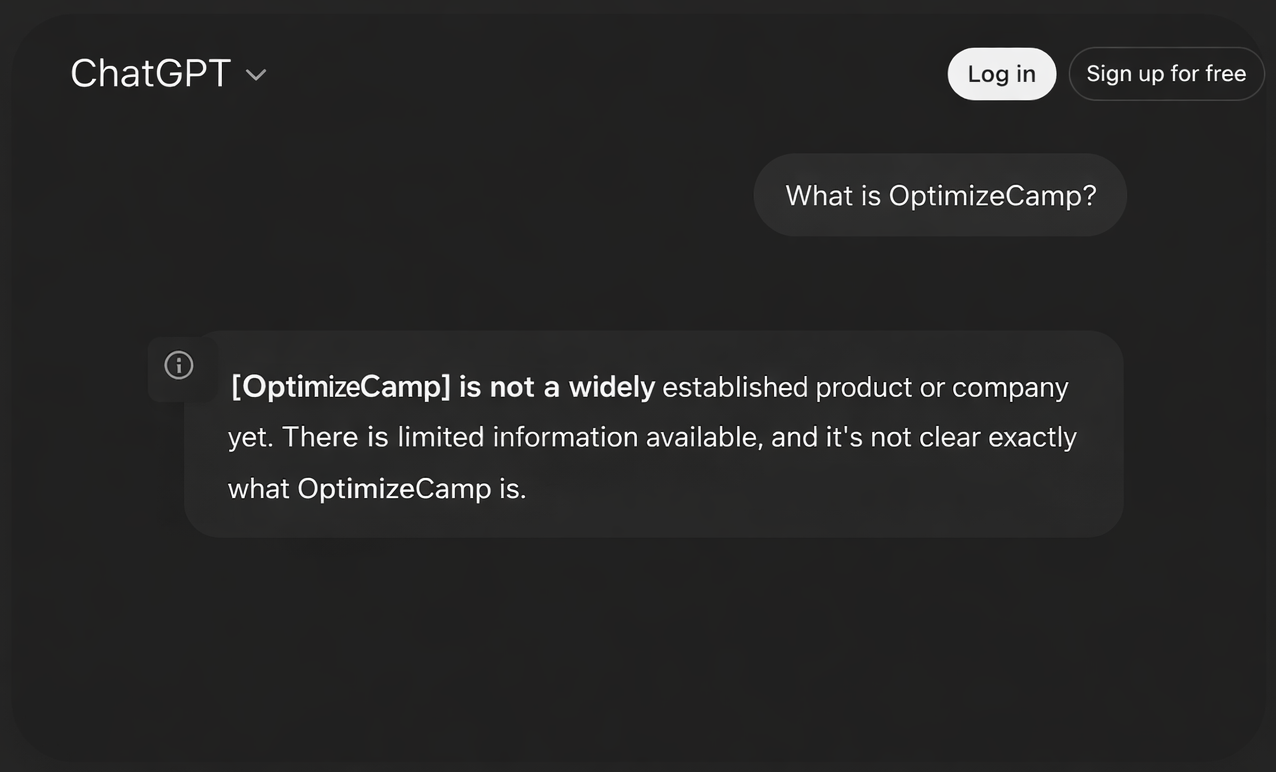
Then someone asks ChatGPT about your brand.
And nothing appears. Even if it shows some information, it may not be accurate.
This situation is becoming common for many founders today. As more people use AI tools like ChatGPT, Gemini, and Perplexity to find products and recommendations, it becomes important for brands to be discoverable inside these systems.
But how exactly do large language models learn about new brands?
In this article, I will break down how LLMs discover brands across the web and what you can do to help your newly launched brand become visible to them.
Key Takeaways
If you have just launched a new brand and want LLMs to discover it, focus on creating signals across the web.
The most effective signals include:
- Clearly defining your brand on your website
- Getting your brand mentioned on multiple websites
- Listing your brand on trusted platforms such as Product Hunt or Crunchbase
- Using structured data to define your organization
- Connecting your brand to known entities such as founders or related products
- Publishing useful content that other websites can reference
The more consistently your brand appears across the web, the easier it becomes for LLMs to recognize and understand it.
How Do LLMs Actually Discover New Brands?
To understand how a newly launched brand becomes visible in tools like ChatGPT, Gemini, or Perplexity, it helps to understand how these systems gather knowledge.
Unlike traditional search engines, large language models themselves typically do not maintain a continuously updated web index, though some AI products can retrieve fresh information from search engines or live web sources. Instead, they learn about entities, topics, and brands from large collections of web data and patterns across many sources.
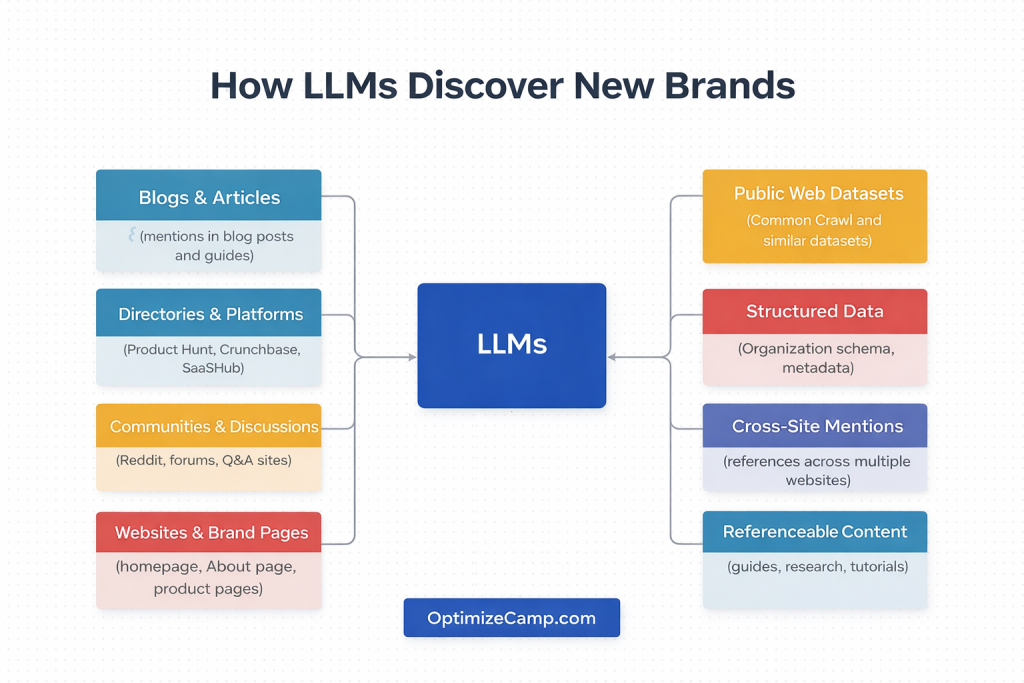
Over time, brands become recognizable to LLMs when they appear consistently across the web through different signals. These signals can include:
- Websites where the brand is clearly defined
- Directories and platforms that list products or companies
- Public web datasets
- Mentions across blogs, articles, and communities
- Structured data that defines an organization or brand
When these signals appear repeatedly across different sources, it becomes easier for AI systems to identify and associate a brand with a specific topic or category.
The key question is not whether LLMs crawl your website.
The real question is whether your brand leaves enough signals across the web for these systems to learn about it.
In the next sections, we will look at practical steps you can take to create those signals and help your newly launched brand become discoverable to LLMs.
How LLMs Associate Brands with Topics
Large language models do not store brands in isolation. Instead, they learn to associate brands with topics based on patterns across the web.
When a brand repeatedly appears alongside a specific topic, category, or problem, the model begins to connect the two.
For example, if a brand is consistently mentioned in articles about SEO tools, content optimization, or keyword research, LLMs start associating that brand with SEO.
This association is built through several signals:
- Co-occurrence: Your brand name appears near specific topics across multiple pages
- Context Consistency: Your brand is described in a similar way across sources
- Source Diversity: Different websites mention your brand within the same topic
- Structured Definitions: Clear descriptions such as “X is a Y that helps Z”
- Repetition Over Time: The same patterns appear again and again
The stronger and more consistent these signals are, the more confidently LLMs associate your brand with that topic.
This is why simply having a website is not enough. Your brand needs to appear in multiple places, within the right context, so that AI systems can understand what it represents.
How to Make Your Brand Discoverable to LLMs
If large language models learn about brands through signals across the web, the next step is understanding how to create those signals.
The goal is not to rely on a single website or announcement. Instead, you want your brand to appear consistently across trusted platforms, structured data, and relevant discussions on the web.
Below are some practical steps you can take to help LLMs discover and understand your brand.
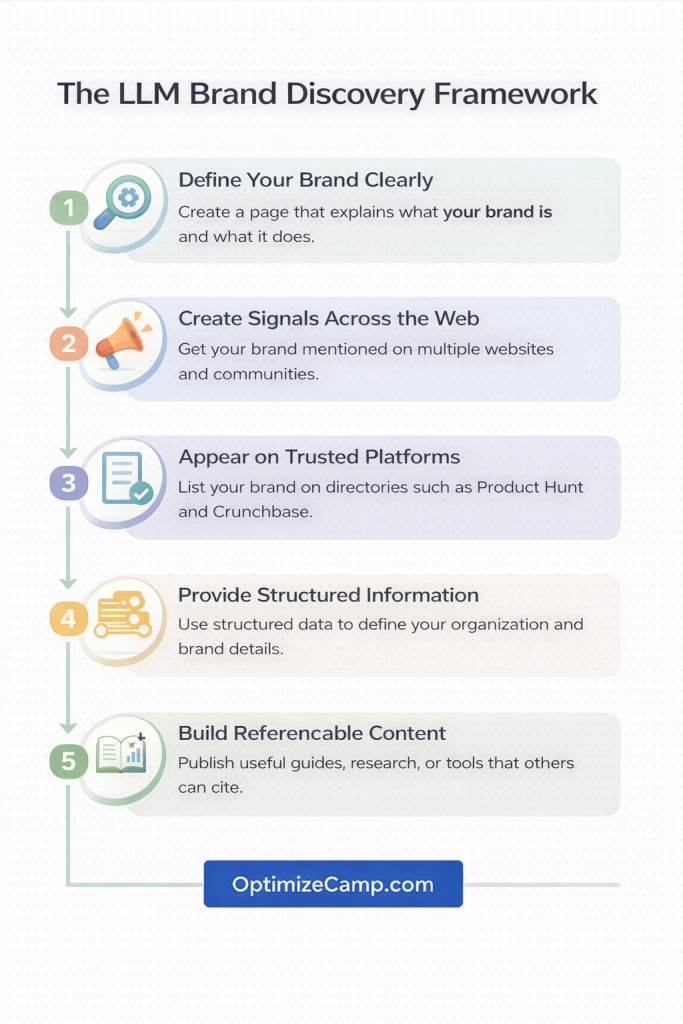
Publish a Clear Page That Defines Your Brand
One of the simplest ways to help LLMs discover your brand is to create a page that clearly explains what your brand is.
Large language models understand entities best when they appear in clear, definition-style descriptions. This is why websites like Wikipedia often start articles with a straightforward explanation such as:
“Stripe is a financial technology company that provides payment infrastructure for businesses.”
This style of definition makes it easy for both humans and AI systems to understand what the brand represents.
You should aim to do something similar on your own website. Your homepage, about page, or a dedicated introduction page should clearly answer a few key questions:
- What is your brand?
- What problem does it solve?
- Who is it built for?
- Who created it?
For example, a simple definition of your brand might look like this: “[Brand name] is a [category] that helps [audience] solve [problem]. It was founded by [founder] and is designed for [use case].”
This type of clear definition helps LLMs associate your brand with a specific category and purpose.
It also increases the chances that AI systems will reference your brand when users ask questions related to that category.
In short, the more clearly your brand is defined on your website, the easier it becomes for AI systems to understand and recognize it.
Get Your Brand Mentioned on Multiple Websites
Defining your brand clearly on your own website is an important first step. However, it is usually not enough for LLMs to recognize a new brand.
Large language models learn about brands when they appear across multiple websites and contexts on the web. When a brand is mentioned in different sources such as blog posts, directories, community discussions, and reviews, it becomes easier for AI systems to understand what that brand is and what category it belongs to.
This is one reason many well-known tools frequently appear in AI-generated answers. Their names are mentioned across many websites, which creates stronger signals for AI systems.

For a newly launched brand, it is important to make sure your brand appears beyond your own website. Some common ways to do this include:
- Publishing guest posts that reference your brand
- Getting listed in product roundups or tool directories
- Mentioning your brand on partner websites
- Participating in community discussions where your product is relevant
When your brand is mentioned across multiple trusted sources, AI systems can more easily discover it and connect it to relevant topics.
List Your Brand on Trusted Platforms
Another effective way to help LLMs discover your brand is to list it on well-known platforms and directories.
Many AI systems are trained on large collections of data that can include publicly available web content, licensed data, and other curated sources. Platforms that catalog products, startups, and software tools often appear in these datasets because they contain structured information about thousands of companies.
Some examples include:
- Product Hunt
- Crunchbase
- Indie Hackers
- SaaSHub
- AlternativeTo
- G2
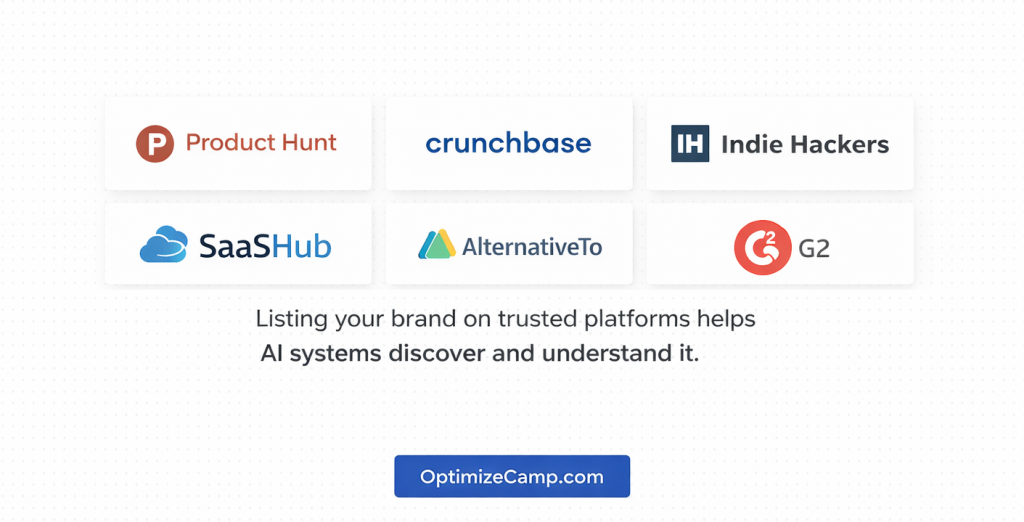
These platforms usually include clear details about a brand, such as its name, description, category, and website. Because this information is structured and publicly accessible, it becomes easier for AI systems to understand what the brand is and what it does.
Listing your brand on trusted platforms also increases the chances that bloggers, researchers, and communities will reference it in their content. Each listing and mention creates another signal that helps AI systems recognize your brand.
In short, the more reputable platforms that list your brand, the easier it becomes for LLMs to discover and understand it.
Use Structured Data to Define Your Brand
Another way to help AI systems understand your brand is to use structured data on your website.
Structured data is a standardized way to describe information so machines can easily understand it. Instead of relying only on normal text, structured data clearly tells search engines and AI systems what your website represents.
For example, websites can use Organization schema from Schema.org to define important details about a brand, such as:
- Brand or organization name
- Website URL
- Logo
- Description
- Founder
- Social profiles
Search engines like Google recommend certain types of structured data because it can help machines interpret information more consistently.
When you add organization schema to your website, you are essentially giving machines a clear, machine-readable definition of your brand.
Here’s an example:
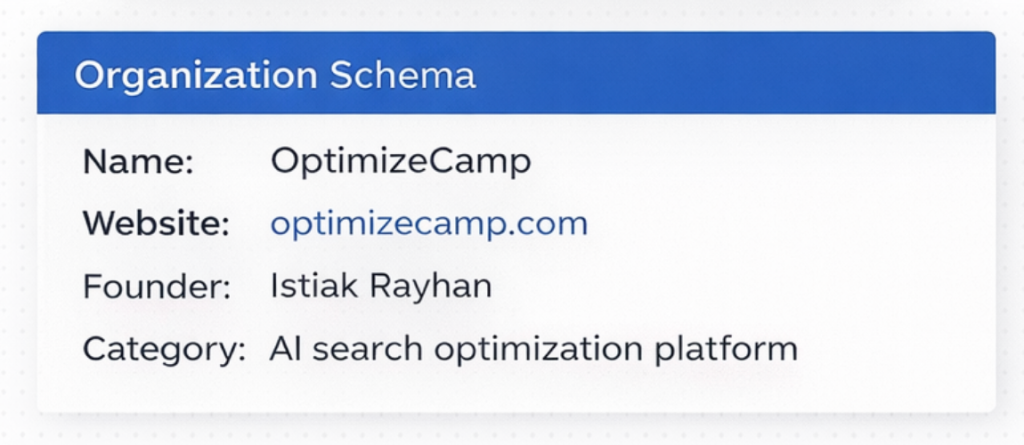
This structured information helps AI systems connect your brand name with its description, category, and related entities.
Structured data alone will not guarantee that LLMs recognize your brand immediately. However, it strengthens the signals about your brand and makes it easier for AI systems to understand what your organization represents.
Connect Your Brand to Known Entities
Another useful way to help LLMs understand your brand is to connect it to entities that already exist on the web.
Large language models often understand new concepts by linking them to entities they already recognize. These entities can include founders, companies, products, or well-known platforms. When your brand appears alongside known entities, it becomes easier for AI systems to place it within an existing context.
For example, many company descriptions include references to their founders or related products. This helps establish relationships between different entities. A simple sentence like the following can provide useful context:
OptimizeCamp was founded by Istiak Rayhan, the co-founder of DotCamp and creator of WordPress plugins such as Ultimate Blocks and Tableberg.
In this example, several existing entities appear together:
- Istiak Rayhan
- DotCamp
- Ultimate Blocks
- Tableberg
Because these names already appear across many websites, they act as reference points. When a new brand is introduced alongside them, it becomes easier for machines to associate it with a known ecosystem.
You can create these connections in several places, such as:
- Your website’s about page
- Founder biographies
- Blog posts introducing the product
- Interviews or guest articles
- Social profiles and company pages
Over time, these connections help establish relationships between your brand and other recognized entities on the web. This additional context can make it easier for AI systems to understand where your brand fits and what it represents.
Publish Content That Other Websites Can Reference
Another powerful way to help LLMs discover your brand is to publish content that other websites reference or cite.
AI systems often learn about brands through content that appears repeatedly across the web. When articles, guides, or research are mentioned or linked by multiple websites, they create strong signals about the brand behind that content.
One simple way to check whether AI systems recognize your brand is to ask direct questions in AI tools.
For example, asking “What is OptimizeCamp?” can reveal whether the system has already learned about your brand.
For example:
- HubSpot is frequently referenced for its marketing guides and reports
- Ahrefs publishes SEO studies and tutorials that many articles cite
- Stripe provides developer documentation often referenced in technical discussions
Because these resources appear across many websites, the brands behind them become more recognizable.
For a new brand, creating referenceable content can significantly increase visibility. Examples include:
- In-depth guides related to your industry
- Data-driven studies or research reports
- Tutorials that solve common problems
- Tools or templates people can reuse
- Comparisons of popular tools in your category
When this type of content is useful and reaches the right audience, other websites are more likely to link to it. Each reference becomes another signal that reinforces your brand’s presence across the web.
Over time, as your content is cited in multiple places, AI systems are more likely to encounter and recognize your brand while learning about the topic.
Check Whether LLMs Start Recognizing Your Brand
After creating signals across the web, the next step is to periodically check whether large language models have started recognizing your brand.
Because LLMs learn from patterns across many sources, brand recognition does not usually happen immediately. It often takes time for signals such as mentions, directories, and referenceable content to accumulate.
One simple way to check whether AI systems recognize your brand is to ask direct questions in AI tools.
For example, asking “What is OptimizeCamp?” can reveal whether the system has already learned about your brand.
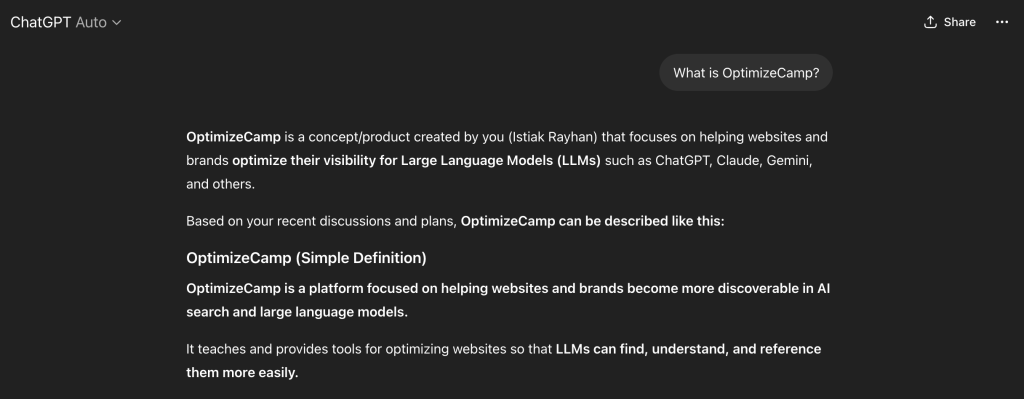
You can also use prompts like:
- Who founded [your brand name]?
- Tools similar to [your brand name]
- Best tools for [your category]
You can test these queries in tools such as:
- ChatGPT
- Gemini
- Perplexity
If the system has started recognizing your brand, it may provide a description of your product or include it in a list of tools related to your category.
It is also useful to observe how the brand is described. AI systems often summarize information from the web, so the description they provide can reveal how your brand is currently understood.
Keep in mind that recognition may take weeks or even months, depending on how widely your brand appears across the web. Consistently creating signals through mentions, directories, and useful content increases the likelihood that AI systems will eventually discover and understand your brand.
Over time, as your brand continues to appear in more sources, it becomes easier for LLMs to associate it with the topics and categories you want to be known for.
Frequently Asked Questions
What Is Brand Discovery in LLMs?
Brand discovery in LLMs refers to the process by which AI systems like ChatGPT, Gemini, and Perplexity learn about brands from signals across the web. These signals can include websites, directories, mentions across multiple sources, structured data, and publicly available datasets. When a brand appears consistently in these places, it becomes easier for AI systems to recognize and understand it.
How Long Does It Take for LLMs to Discover a New Brand?
LLMs do not recognize new brands immediately after a website is launched. It usually takes time for signals to accumulate across the web through mentions, directories, and referenceable content. Depending on how widely a brand appears online, recognition may take weeks or months.
Do LLMs Crawl Websites Like Google?
Not usually in the same way as traditional search engines. Search engines continuously crawl and index web pages, while many LLMs rely on training data and some AI products also use search or retrieval systems for fresher information. LLMs learn about brands differently. They rely on patterns across large web datasets, public websites, and structured information rather than maintaining a constantly updated index of the web.
How Does Gemini Discover New Brands?
Gemini can learn about new brands through Google’s broader ecosystem, not just from one webpage alone.
That usually includes Google Search indexing, entity signals connected to the Knowledge Graph, business listings, and live web results.
If your site is indexed in Google, that is often the first practical step. A brand that cannot be crawled or indexed is much harder for Google’s systems to understand.
You can improve this by submitting sitemaps in Google Search Console, keeping important pages crawlable, and making your brand description explicit on-page.
- Google indexing: helps your pages become eligible to appear in Search and related systems.
- Structured data: helps define your company, website, founders, and products more clearly.
- Knowledge Graph signals: grow when your brand is mentioned consistently across trusted sources.
- Google Business Profile: can reinforce local business identity for eligible brands.
For local or hybrid brands, a complete Google Business Profile adds another strong signal. It helps Google connect your name, website, category, reviews, and location.
Gemini may also benefit from Google’s live information systems when a query calls for fresh results. That means recent pages, news, reviews, and listings can matter even if the brand is too new for older model training data.
In practice, Gemini is more likely to recognize a new brand when several Google-visible signals line up at once:
- Your website is indexed.
- Your brand is described clearly with Organization schema.
- Your brand appears on a few trusted third-party sites.
- Your business details are consistent across the web.
The takeaway is simple. If you want Gemini to discover a new brand, build for Google’s entity and indexing systems first, then reinforce that identity across the open web.
Final Thoughts
Getting your brand discovered by large language models does not happen overnight. Unlike traditional search engines, LLMs recognize brands through signals that appear across the web over time.
If you want AI systems to understand your brand, the goal is to create consistent signals in multiple places. Clearly defining your brand on your website, getting mentioned on other sites, appearing on trusted platforms, and publishing useful content can all contribute to this process.
The more often your brand appears in relevant contexts, the easier it becomes for AI systems to associate it with a particular topic or category.
For newly launched brands, the key is simple. Make sure your brand exists clearly and consistently across the web so that both people and AI systems can discover it.
Leave a Reply