

Something shifted in Google. Quietly at first. Then all at once.
AI Overviews now sit above every organic result. They answer the question before a single click happens. For some queries, 26% of users read the AI answer and leave. They never scroll down. They never visit your site.
The old playbook was simple. Rank high. Get clicks. That’s over. Position #1 now loses 58% of its clicks when an AI Overview appears. That number was 34.5% eight months earlier. The decline is accelerating.
But here’s what most people miss. Brands cited inside AI Overviews earn 35% more organic clicks than uncited brands on the same query. AI Overviews don’t destroy all traffic. They redistribute it. Toward cited sources. Away from everyone else.
This guide covers everything. How the pipeline works. Why query fan-out changes your strategy. Which tactics are proven by data. What Google officially says. Every claim sourced. Every stat verified.
What Are Google AI Overviews?
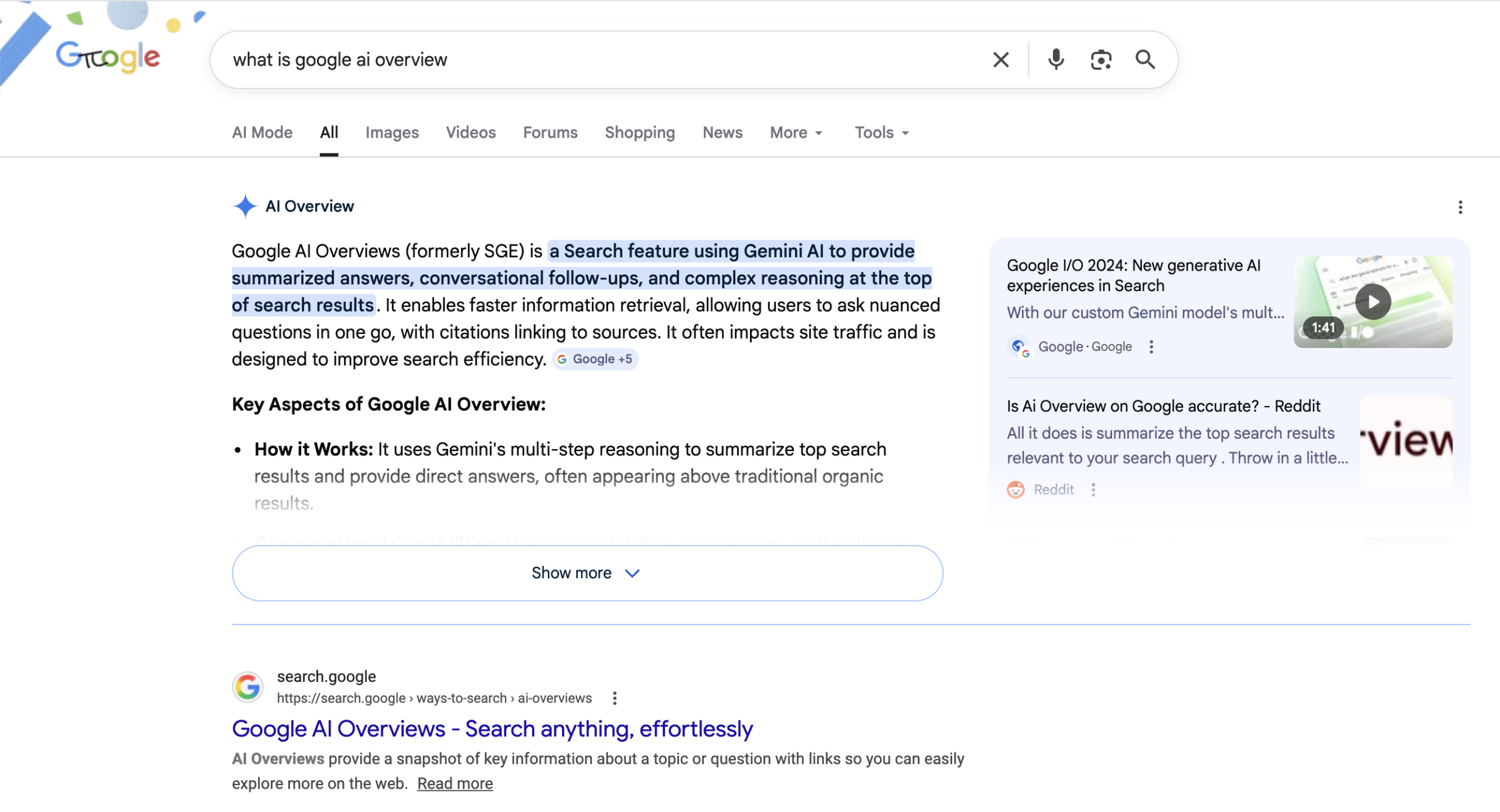
Google AI Overviews are AI-generated summaries above organic search results. They synthesize information from multiple web sources into one answer. The user sees a complete response without clicking a single link.
They launched in May 2024. By March 2026, they reach over 2 billion monthly users across 200+ countries. They run on Gemini 3, Google’s most advanced AI model for search.
Traditional search showed ten blue links. You clicked one. Now Google reads those pages for you. It pulls the best sentences from each source. It assembles one coherent answer. Then it cites the sources it used.
Your content is either cited – or invisible.
The Numbers That Explain The Urgency
Before tactics, you need context. These numbers explain why AIO optimization matters right now.
That last stat is critical. AI Overviews hurt uncited brands. But they help cited brands. Being cited earns you 35% more organic clicks and 91% more paid clicks than competitors on the same query.
The Pew Research Center tracked real browsing behavior of 900 US adults across 68,879 searches. Only 8% of searches with AIOs resulted in a click. 26% of users left entirely after reading the overview. If you’re not cited, the user never reaches your site.
How AI Overviews Choose Which Pages To Cite
AI Overviews use a five-stage pipeline. Each stage is a filter. Your content must survive all five to earn a citation. Understanding where most pages fail tells you exactly where to optimize.
Each stage eliminates candidates. Most content fails at Stage 4. It ranks well but doesn’t provide the complete, extractable answer the AI needs. The fix isn’t better SEO. It’s deeper, more comprehensive content.
Query Fan-Out: The Mechanism Nobody Is Talking About
This is the most important concept in AIO optimization. It explains why ranking #1 no longer guarantees a citation. And why pages that never cracked the top 10 are earning them.
When you search, Google doesn’t run one query. It runs 8-12 simultaneously. Each sub-query targets a different facet of your question. Google confirmed this at I/O 2025. With Gemini 3, it got “a major upgrade.”
The Data Is Striking
Surfer SEO studied 10,000 keywords and 173,902 URLs. They extracted 33,000 fan-out queries. The results reshape how we think about AIO optimization.
One critical caveat. Only 27% of fan-out queries stay stable. The other 73% change each time. Targeting specific fan-out keywords is pointless.
The strategy is comprehensive topical coverage. Ekamoira’s research found sites with 80%+ topical coverage retain 85.4% of their AI visibility despite fan-out instability. Cover the full landscape – pros, cons, pricing, comparisons, implementation – and you naturally appear across whatever sub-queries Google generates.
12 Proven Optimization Tactics (Ranked By Impact)
Each tactic below is backed by at least one published study. Ranked by data strength.
The Ideal Content Structure For AIO Citations
Data from multiple studies converges on a specific structural blueprint. Here’s what an AIO-optimized page looks like.
E-E-A-T: The Trust Filter AI Overviews Apply First
E-E-A-T stands for Experience, Expertise, Authoritativeness, and Trustworthiness. Google uses it to decide whether a source is credible. For AI Overviews, E-E-A-T operates as a pass/fail gate. Fail it and you’re eliminated before the AI evaluates your content quality.
→ First-person result sharing
→ Specific details only a user would know
→ Timelines: “After 6 months of using…”
→ Cite primary sources, not aggregators
→ Cover nuances competitors skip
→ Use precise terminology correctly
→ Build comprehensive topical depth
→ Earn backlinks from domain authorities
→ Be active on YouTube, Reddit, LinkedIn
→ Show clear contact and org identity
→ No unsupported medical/financial claims
→ Disclose affiliations and potential bias
The bar isn’t the same for every topic. Healthcare AIOs have 24% top-10 overlap – Google sticks to trusted medical sources. Finance shows only 11.3%. Technology is more open but still requires freshness and depth.
Danny Sullivan warned against gaming E-E-A-T with fake “expert reviewed” labels. The signal needs to be real. AI engines cross-reference author credentials with actual publishing history.
Technical Requirements (Surprisingly Simple)
Google’s Search Central docs are clear: “There are no additional requirements to appear in AI Overviews.” Your page must be indexed and eligible to show a snippet. No special schema. No llms.txt file. No AI-specific markup.
nosnippet or noindex tagsnosnippet blocks AIOs but also removes traditional snippets. Google-Extended blocks AI training but NOT AIO appearance.7 Mistakes That Kill Your AIO Visibility
User-agent: * with Disallow: / blocks everything – including Googlebot. The most destructive technical error.What Google Officially Says (And What The Data Contradicts)
Google’s position is simple. Their docs state: “There are no additional requirements to appear in AI Overviews or AI Mode.”
Danny Sullivan put it bluntly at WordCamp US 2025: “Good SEO is good GEO.” He urged publishers to create “original value… perspective, expertise, reporting, firsthand experience.”
But Google also claims organic click volume is “relatively stable year-over-year.” This directly contradicts Ahrefs’ 58% CTR decline, Seer Interactive’s 61% organic drop, and Pew Research Center’s behavioral tracking data. Independent studies paint a very different picture.
Practical takeaway: Follow Google’s content quality guidance. But measure the traffic impact with your own data. Don’t take Google’s word for it.
How To Track Your AIO Citations
AIO citations are volatile. They change roughly every 2.15 days according to Ahrefs. 45.5% of cited sources are entirely new each observation. Monitoring is essential.
Start simple. Pick your 10 most important keywords. Search them in Google. Note which pages get cited. Do this monthly. That’s your baseline.
For scale, use dedicated tools. Ahrefs Brand Radar tracks 210M+ prompts across 7 AI platforms. SEMrush’s AI Visibility Toolkit provides competitor gap analysis at $199/month. Otterly.ai covers 25+ GEO factors starting at $29/month. OptimizeCamp audits the content itself — checking the accuracy, authority, and citability signals AIOs evaluate when selecting sources.
Frequently Asked Questions
Do I Need To Rank In The Top 10 To Appear In AI Overviews?
No. Only 38% of AIO citations come from top-10 pages as of March 2026. 31% come from pages ranking beyond position 100. Comprehensive topical coverage matters more than ranking position.
How Often Do AI Overview Citations Change?
Roughly every 2.15 days. 45.5% of cited sources are entirely new each observation. A citation earned today may disappear within days. Continuous freshness is essential.
What Is Query Fan-Out?
Google’s technique of breaking one query into 8–12 parallel sub-queries. Each targets a different facet. Google confirmed this at I/O 2025. Pages appearing across multiple sub-queries are 161% more likely to be cited.
Can I Opt Out Of AI Overviews?
Not without consequences. The nosnippet tag blocks AIOs but also removes your traditional search snippets. There’s currently no AIO-specific opt-out. Google says they’re exploring options.
Does Schema Markup Help?
Google says it’s not required. But Schema App measured a 19.72% increase in AIO visibility for pages with proper markup. Article, FAQPage, HowTo, and Organization schemas are most valuable.
How Do I Check If My Content Is AIO-Ready?
Run a GEO content audit. Check accuracy (are claims verifiable?), authority (is the topic fully covered?), and citability (can AI extract clean claims?). OptimizeCamp automates all three and flags the specific sentences that need fixes.
Leave a Reply