

Here’s an uncomfortable truth. 89% of websites are unprepared for AI search. Not “could be better.” Unprepared. Their content is invisible to ChatGPT, Perplexity, and Google AI Overviews.
You probably already do SEO audits. You check rankings. You fix broken links. You optimize meta tags. That’s table stakes now. A GEO audit asks a different question entirely.
Not “can Google find this?” but “would an AI trust and cite this?”
Those are fundamentally different questions. Google ranks pages. AI engines quote sentences. Google rewards keywords. AI engines reward verifiable claims. Google cares about backlinks. AI engines care about whether your facts check out.
89%
of websites are completely unprepared for AI-powered search. Most don’t even know they have a problem until traffic starts falling.
Source: Geoptie analysis of 10,000+ websites, 2025
A GEO audit catches problems SEO audits miss. Wrong statistics that AI engines will verify and reject. Missing source citations that make AI engines distrust you. Walls of unstructured text that AI can’t extract quotes from. Topic gaps that competitors fill but you don’t.
The cost of not auditing is clear. Publishers report traffic losses of up to 40% when AI summaries appear above their content. That number will only grow. AI Overviews already appear on 16% of US searches. By year-end, that could double.
How a GEO audit differs from an SEO audit
An SEO audit checks if search engines can crawl your page. A GEO audit checks if AI engines would cite it. Same content. Completely different lens.
| Traditional SEO Audit | GEO Content Audit | |
|---|---|---|
| Core question | “Can Google find and rank this?” | “Would AI trust and cite this?” |
| Evaluates | Keywords, meta tags, backlinks, page speed | Accuracy, authority depth, citability, freshness |
| Unit of analysis | The page as a whole | Individual claims and sentences |
| Success looks like | Higher ranking position | AI engines quoting your content |
| Checks facts? | No | Yes — every verifiable claim |
| Checks competitors? | Keyword overlap, backlink gaps | Subtopic coverage gaps, format gaps |
| Checks structure? | H1 tags, internal links | Extractable claims, heading hierarchy, FAQ presence |
| Update frequency | Quarterly or annually | Every 60–90 days (AI favors fresh content) |
The biggest difference is at the claim level. An SEO audit looks at the page. A GEO audit looks at every sentence on that page. Because AI engines extract sentences, not pages.
Think about it. When ChatGPT answers a question, it doesn’t link to your whole article. It pulls one specific sentence — one fact, one statistic, one claim — and uses it in the answer. If that sentence is vague, unsourced, or wrong, you don’t get cited.
A GEO audit evaluates your content the way AI engines do. Sentence by sentence.
The 5-dimension GEO audit framework
Most content audits use a single score. That’s useless for GEO. You need to know exactly which dimension is failing. A page might be factually perfect but structurally invisible to AI. Or beautifully formatted but full of outdated statistics.
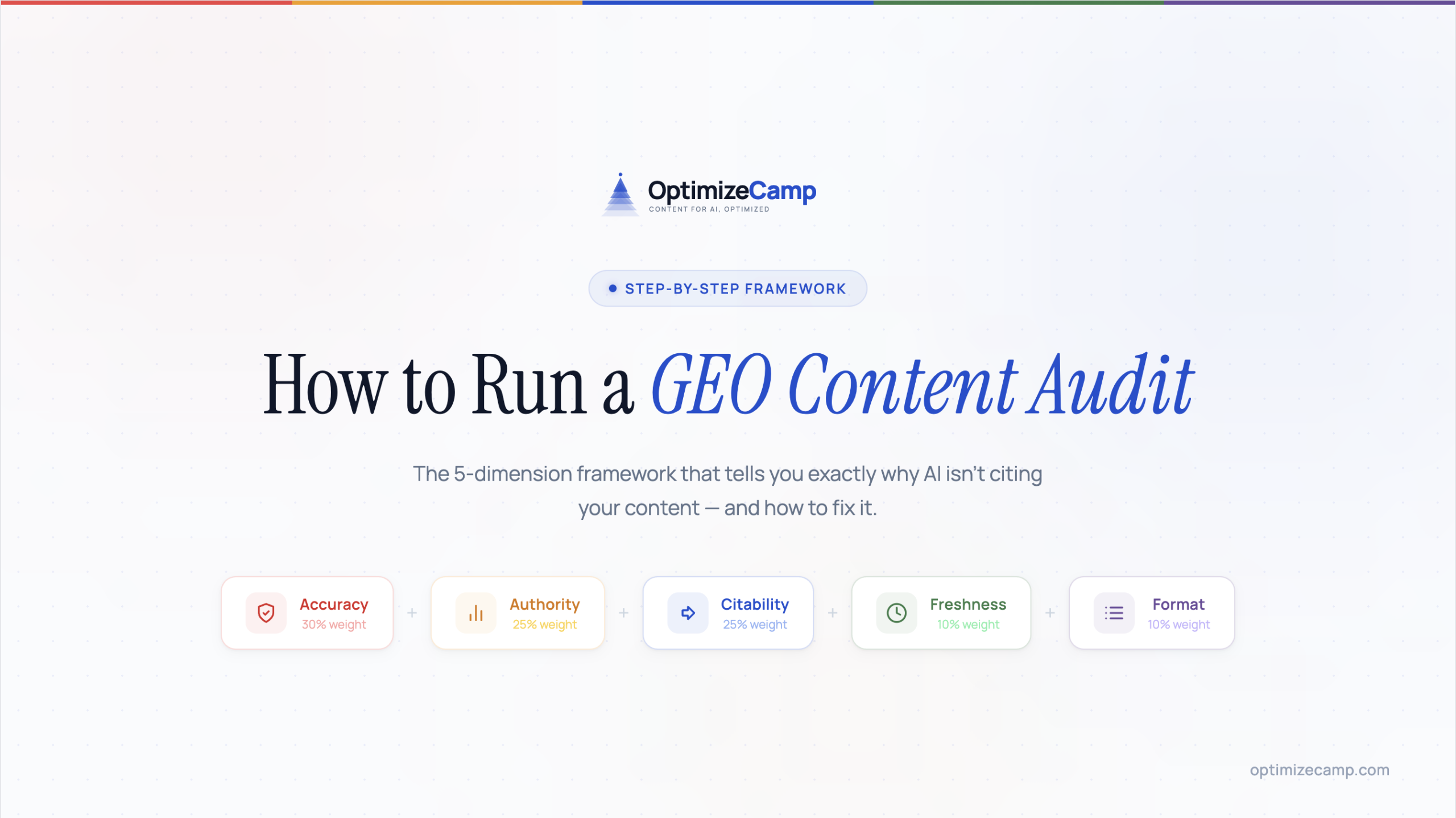
This framework evaluates five independent dimensions. Each one maps to a specific reason AI engines do — or don’t — cite your content.
01
Accuracy
Are your facts actually true? AI engines verify claims before citing them.
02
Authority
Do you cover the topic as deeply as your top competitors?
03
Citability
Can AI extract clean, quotable claims from your content?
04
Freshness
Is your content current enough for AI to trust? 79% of AI bots prefer recent content.
05
Format
Does your content have the structural elements AI engines expect? Tables, FAQs, lists.
Each dimension gets a score from 0–100. Together, they tell you exactly why AI engines are ignoring your content. Not a vague “your content needs work.” A specific “your accuracy is 92 but your citability is 34 — AI can’t extract clean quotes from your text.”
Let’s break down each dimension.
Dimension 1
Accuracy — can AI trust your facts?
This is the most important dimension. And the one nobody else audits for. Traditional content audits check grammar. Maybe readability. They never check whether your claims are actually true.
AI engines do. Every time.
When an LLM considers citing your content, it cross-references your claims against its training data and web sources. One wrong statistic doesn’t just lose you one citation. It makes the AI distrust your entire page. Everything connected to that source gets downgraded.
What to check
- Every statistic in your content. Is the number correct? Is the source credible? Is it current? A 2022 statistic about AI adoption is ancient history in 2026.
- Every named claim. Did that company really raise $50M? Did that study really say what you claim? Misquoted research kills credibility fast.
- Logical coherence. Do your claims contradict each other? Does paragraph 3 say “AI traffic is growing 300%” while paragraph 8 says “AI hasn’t impacted most sites”? AI engines catch inconsistencies.
- Source attribution. Do you name your sources inline? “Studies show” means nothing. “A Princeton University study published at KDD 2024 found” means everything.
- Outdated claims. Anything with a year, a “recently,” or a “this year” needs to be checked. “In 2024, AI Overviews appear on 8% of searches” is wrong in 2026. The number is now 16%.
How to score it
Start at 100. Deduct for every issue found.
| Issue Type | Deduction | Why It Matters |
|---|---|---|
| Factually incorrect claim | -15 per claim | AI will verify this and reject your page |
| Outdated statistic (6+ months) | -12 per stat | AI engines favor recent, accurate data |
| Unsourced statistic | -5 per stat | No attribution = lower trust score |
| Logical inconsistency | -10 per instance | Contradictions signal unreliable content |
| Vague claim (“many experts say”) | -3 per instance | AI can’t extract or verify vague claims |
A page with three wrong statistics starts at 55. That’s a failing grade. Two unsourced numbers and a contradiction drops you to 30. At that point, no AI engine is citing you. Period.
Real example: We audited a SaaS blog post claiming “72% of marketers use AI for content creation (HubSpot, 2023).” The actual HubSpot figure was 64%. And it was from their 2024 report, not 2023. Two errors in one sentence. That single sentence would have tanked the page’s AI credibility.
Dimension 2
Authority — do you cover the topic deeply enough?
AI engines don’t just check if your content exists. They compare it to every other source on the topic. If three competitors cover a subtopic and you don’t, that’s an authority gap. And authority gaps directly reduce your citation probability.
This dimension is closest to traditional SEO content auditing. But the lens is different. You’re not checking for keyword gaps. You’re checking for topic depth gaps.
What to check
- Subtopic coverage. Search your target keyword. Look at the top 10 results. List every H2 and H3 subtopic they cover. Which ones are you missing?
- Coverage depth. Competitors write 500 words on “GEO metrics.” You wrote 50. That’s an authority gap even if you mention the topic.
- Format gaps. Do competitors include comparison tables? Pros/cons sections? Step-by-step walkthroughs? If they do and you don’t, AI sees your content as less comprehensive.
- Entity coverage. Do competitors mention specific tools, people, studies, or frameworks by name? Named entities are anchor points for AI engines. More entities = more citation opportunities.
- Unique angle. Do you offer any insight competitors don’t? Original data, proprietary frameworks, or first-hand experience? AI engines value unique contributions heavily.
How to score it
This one’s relative. You’re scoring against the competition.
| Gap Type | Deduction | When It Applies |
|---|---|---|
| Missing subtopic (6+ competitors cover it) | -12 per gap | Critical gap. AI considers this essential. |
| Missing subtopic (4–5 competitors) | -7 per gap | Important gap. Should be addressed. |
| Missing subtopic (2–3 competitors) | -3 per gap | Minor gap. Nice to have. |
| Missing format element (tables, pros/cons) | -5 per element | Max -15 total for format gaps. |
| Thin coverage (under 30% of competitor avg) | -8 per section | You mention it but barely. |
If you only cover a subtopic only 1 competitor mentions, that’s not a real gap. AI engines look for consensus. A topic needs to appear in at least 2 of the top 10 results to count as an authority signal.
The key insight: depth beats breadth. A 4,000-word article covering 8 subtopics deeply will outperform a 6,000-word article covering 15 subtopics superficially. AI engines want to cite the best source on each sub-question, not the longest page overall.
Dimension 3
Citability — can AI actually quote you?
This is the dimension most people miss entirely. Your content might be accurate and authoritative. But if AI can’t extract clean, quotable claims from it, none of that matters.
Citability is about structure. About how you write individual sentences. About whether your insights are extractable by a machine that reads differently than a human.
The extractability test
Read your page sentence by sentence. For each key insight, ask: “Would this sentence make sense to someone who hasn’t read anything else on this page?”
If yes — it’s extractable. If no — it’s invisible to AI.
❌ Not extractable
“This means that, as we discussed earlier, the impact has been quite significant for many businesses in the space.”
Vague. Requires context. No data. No specifics. AI can’t use this.
✅ Extractable
“Publishers report traffic losses of up to 40% when AI Overviews appear above their organic listings.”
Specific. Self-contained. Verifiable. AI can cite this directly.
What to check
- Self-contained claims. Count how many of your key sentences work as standalone facts. Aim for 70%+.
- Inline citations. Do you name sources inside sentences? Not just hyperlinks — actual named sources in the text itself.
- Statistics per section. Each H2 section should contain at least 1–2 specific data points. Zero statistics = invisible section.
- Ambiguous pronouns. “They found that it increased significantly.” Who is “they”? What is “it”? By how much? AI can’t cite ambiguity.
- Named entities. Do you reference specific tools, people, organizations, and studies by name? Or do you use vague references like “experts” and “some companies”?
- Sentence length. Sentences over 25 words are harder for AI to extract cleanly. Keep key claims under 20 words when possible.
The Princeton research proved this dimension matters. Content with cited sources, concrete statistics, and expert quotations saw up to 40% more AI visibility. These are citability signals. They’re what separate “good content” from “content AI will actually use.”
Dimension 4
Freshness — does AI consider this current?
Content decay has always existed in SEO. In GEO, it happens faster. Much faster.
79% of AI bots prefer recent content when generating answers. AI engines check publication dates. They evaluate whether statistics are current. They notice when your “2024 guide” hasn’t been touched in 18 months.
In traditional SEO, you could update a page annually and be fine. In GEO, quarterly updates are the minimum. Every 60–90 days is ideal.
What to check
- Last updated date. Is it visible on the page? AI engines look for this. No date = no freshness signal.
- Statistics age. Are your data points from the last 6 months? Flag any statistic older than 12 months for review.
- Temporal language. Search for “this year,” “recently,” “last month,” “in 2024,” “in 2025.” Each one is a potential freshness bomb if it refers to the past.
- Industry changes. Has anything major changed in your topic since you published? New tools? New research? New regulations? If your competitors have updated and you haven’t, they win the citation.
- Broken references. Do your external links still work? Does the study you cited still exist? Dead links signal abandoned content.
Freshness is the easiest dimension to fix. It’s also the easiest to neglect. Set a calendar reminder. Every 90 days, review your top 20 pages. Update the stats. Fix the temporal language. Change the date. It takes 30 minutes per page and it directly impacts whether AI cites you.
Dimension 5
Format — does your page look like something AI expects?
AI engines have format preferences. They’re not subtle about it. Pages with clear heading hierarchies get cited 2.8 times more often. 80% of AI-cited pages contain structured lists. 87% have a unique H1 with an introductory answer.
Format is the structural scaffolding that makes everything else work. You can have perfect accuracy, deep authority, and excellent citability — but if it’s all buried in a wall of text, AI can’t find it.
What to check
| Format Element | What AI Expects | Your Page? |
|---|---|---|
| Heading hierarchy | Clear H1 → H2 → H3 progression. One H1 only. | ✅ / ❌ |
| H2 density | Roughly one H2 per 300 words. Descriptive, not clever. | ✅ / ❌ |
| Intro answers the query | First 100 words should directly answer the page’s core question. | ✅ / ❌ |
| Bulleted/numbered lists | At least 2–3 per page. 80% of cited pages include them. | ✅ / ❌ |
| Comparison tables | When content involves comparing options. Highly extractable by AI. | ✅ / ❌ |
| FAQ section | 3–5 questions at the bottom. Mirrors how users prompt AI. | ✅ / ❌ |
| Schema markup | Article, FAQ, or HowTo JSON-LD. Not required but helps. | ✅ / ❌ |
| Reading level | Flesch-Kincaid grade 8–10. Not too simple. Not too complex. | ✅ / ❌ |
| “Last Updated” visible | Date clearly shown on page. AI engines check this. | ✅ / ❌ |
Use that table as a literal checklist. Print it. Check every box for every page you audit. The pages that fail 3+ of these format checks are almost certainly invisible to AI engines — regardless of how good the content itself is.
Putting It Together
How to score and prioritize
You now have five scores, each from 0–100. But they don’t all weigh equally. Here’s how to create a composite score that reflects how AI engines actually evaluate content.
Composite GEO Score Formula
Accuracy × 0.30 + Authority × 0.25 + Citability × 0.25 + Freshness × 0.10 + Format × 0.10
Accuracy is weighted highest because factual trust is the foundation AI engines need. A beautifully formatted, well-structured page with wrong facts will never get cited.
What the scores mean
| Composite Score | Rating | What It Means |
|---|---|---|
| 80–100 | 🟢 AI-Ready | Content is well-positioned for AI citations. Maintain and update quarterly. |
| 60–79 | 🔵 Needs Work | Solid foundation. Fix the lowest-scoring dimension first for quick gains. |
| 40–59 | 🟡 At Risk | AI engines are probably skipping this content. Prioritize accuracy and citability fixes. |
| 0–39 | 🔴 Invisible | AI engines are not citing this. Needs a full rewrite or major restructure. |
Prioritization rules
Don’t try to fix everything at once. Follow this priority order.
- Fix accuracy issues first. Wrong facts poison everything. One incorrect statistic can make AI distrust your entire page. Always start here.
- Fix citability second. Restructure key claims as self-contained sentences. Add inline citations. This is where the +40% visibility lift from the Princeton study lives.
- Fill authority gaps third. Add missing subtopics your competitors cover. Deepen thin sections. This builds your case as a comprehensive source.
- Update freshness fourth. Swap stale statistics. Fix temporal language. Update the “last modified” date. Quick wins, meaningful impact.
- Fix format last. Add FAQ sections. Improve heading hierarchy. Add tables. These are important but won’t help if the underlying content isn’t trustworthy.
In Practice
Full walkthrough: auditing a real page
Let’s make this concrete. Imagine you’re auditing a blog post titled “Best Project Management Tools for Remote Teams in 2026.” Here’s exactly how you’d walk through each dimension.
Step 1 → Accuracy Scan
You find the article claims “Asana has 150 million users.” Quick verification: Asana’s latest report says 139 million. That’s a -15 deduction. The article says “Monday.com was founded in 2014.” Correct — it was 2012 under a different name, rebranded in 2017. Borderline. Flag it. Two pricing figures are from 2024 and no longer accurate. That’s -12 each. Accuracy score: 61.
Step 2 → Authority Check
You check the top 10 search results. 7 of 10 competitors cover “integration capabilities.” Your article doesn’t mention it. That’s -12. 5 of 10 cover “AI features in PM tools.” You have one sentence on it. That’s thin coverage: -8. You’re also missing a comparison table that 6 competitors include. That’s -5 for format gap. Authority score: 65.
Step 3 → Citability Audit
You check for self-contained claims. Only 4 of 12 key statements work as standalone facts. The rest need context. Pronoun check: 8 instances of “they” without a clear antecedent. Zero inline citations — no sources named in the text. Two sections have no statistics at all. Citability score: 38. This is the killer.
Step 4 → Freshness Review
The article was last updated 11 months ago. No visible “updated” date on the page. Three instances of “in 2025” that now feel stale. Pricing has changed for 4 of the 8 tools listed. One tool (Notion) has launched a major AI feature not mentioned at all. Freshness score: 42.
Step 5 → Format Check
Heading hierarchy is clean — H1 → H2 → H3. Good. But no FAQ section. No comparison table. Only one bulleted list in the entire article. The intro buries the answer in paragraph 3 instead of leading with it. Reading level is fine at grade 9. Format score: 58.
The composite result
Composite GEO Score: 54 — “At Risk.”
The diagnosis is clear. Accuracy is decent (61) but has specific fixable problems. Authority is reasonable (65) with known gaps. Citability is failing badly (38) — this is why AI isn’t citing the page. Freshness needs attention (42). Format is passable (58).
The fix priority: Rewrite key claims as self-contained sentences (citability). Fix the three wrong statistics (accuracy). Add the missing subtopics and comparison table (authority). Update pricing and dates (freshness). Add FAQ section (format).
Total estimated time: 2–3 hours. Expected impact: moving from “AI ignores this page” to “AI considers citing this page.” That’s the whole game.
The Checklist
The complete GEO audit checklist
Copy this. Print it. Use it for every page.
Accuracy (weight: 30%)
- ☐ Every statistic verified against original source
- ☐ Every named claim fact-checked
- ☐ No logical contradictions between sections
- ☐ Sources named inline (not just linked)
- ☐ No “many experts say” without naming experts
Authority (weight: 25%)
- ☐ Compared subtopics against top 10 SERP results
- ☐ No subtopic gap where 4+ competitors cover it
- ☐ Each section has sufficient depth (not surface-level)
- ☐ Format elements match competitors (tables, pros/cons)
- ☐ At least one unique angle competitors don’t offer
Citability (weight: 25%)
- ☐ 70%+ of key claims work as standalone sentences
- ☐ 2-3 cited statistics per H2 section
- ☐ No ambiguous pronouns in key claims
- ☐ Named entities (tools, people, orgs) throughout
- ☐ Key claim sentences under 20 words each
- ☐ Expert quotations included where relevant
Freshness (weight: 10%)
- ☐ “Last Updated” date visible on page
- ☐ All statistics from last 6 months
- ☐ No stale temporal language (“this year” referring to past)
- ☐ External links still work
- ☐ Industry changes since last update are reflected
Format (weight: 10%)
- ☐ Clean H1 → H2 → H3 hierarchy
- ☐ One H2 roughly per 300 words
- ☐ Query answered in first 100 words
- ☐ 2–3 bulleted or numbered lists minimum
- ☐ Comparison table (if applicable)
- ☐ FAQ section with 3–5 questions
- ☐ Schema markup (Article, FAQ, or HowTo)
- ☐ Reading level at grade 8–10
Frequently asked questions
How long does a GEO audit take?
About 30–45 minutes per page for a thorough manual audit. Your first one will take longer. By page five, you’ll have the rhythm. For a full site, budget one week for 20 pages.
How often should I re-audit?
Every 60–90 days for your top 20 pages. AI engines favor fresh content. Quarterly is the minimum. Monthly is ideal for your highest-traffic pages.
Do I need special tools for a GEO audit?
You can start with nothing but this framework and a spreadsheet. For scale, tools like OptimizeCamp automate the accuracy checking, authority gap analysis, and citability scoring. But the framework works manually too.
What’s the difference between GEO and AEO auditing?
AEO (Answer Engine Optimization) focused on featured snippets and voice search. GEO covers all AI-generated answers — ChatGPT, Perplexity, Claude, Google AI Overviews. AEO is now a subset of GEO.
Which pages should I audit first?
Start with your top 10 pages by organic traffic. These have the most to gain and the most to lose. Then audit pages targeting your most valuable commercial keywords.
Can I do this alongside my regular SEO audit?
Absolutely. They complement each other. Run your standard SEO audit first. Then add the five GEO dimensions on top. SEO is the foundation. GEO is the new layer.
Skip the manual audit. Let AI do it.
OptimizeCamp audits all five dimensions automatically — accuracy, authority, citability, freshness, and format — then gives you inline fixes you can apply in one click.
Leave a Reply