

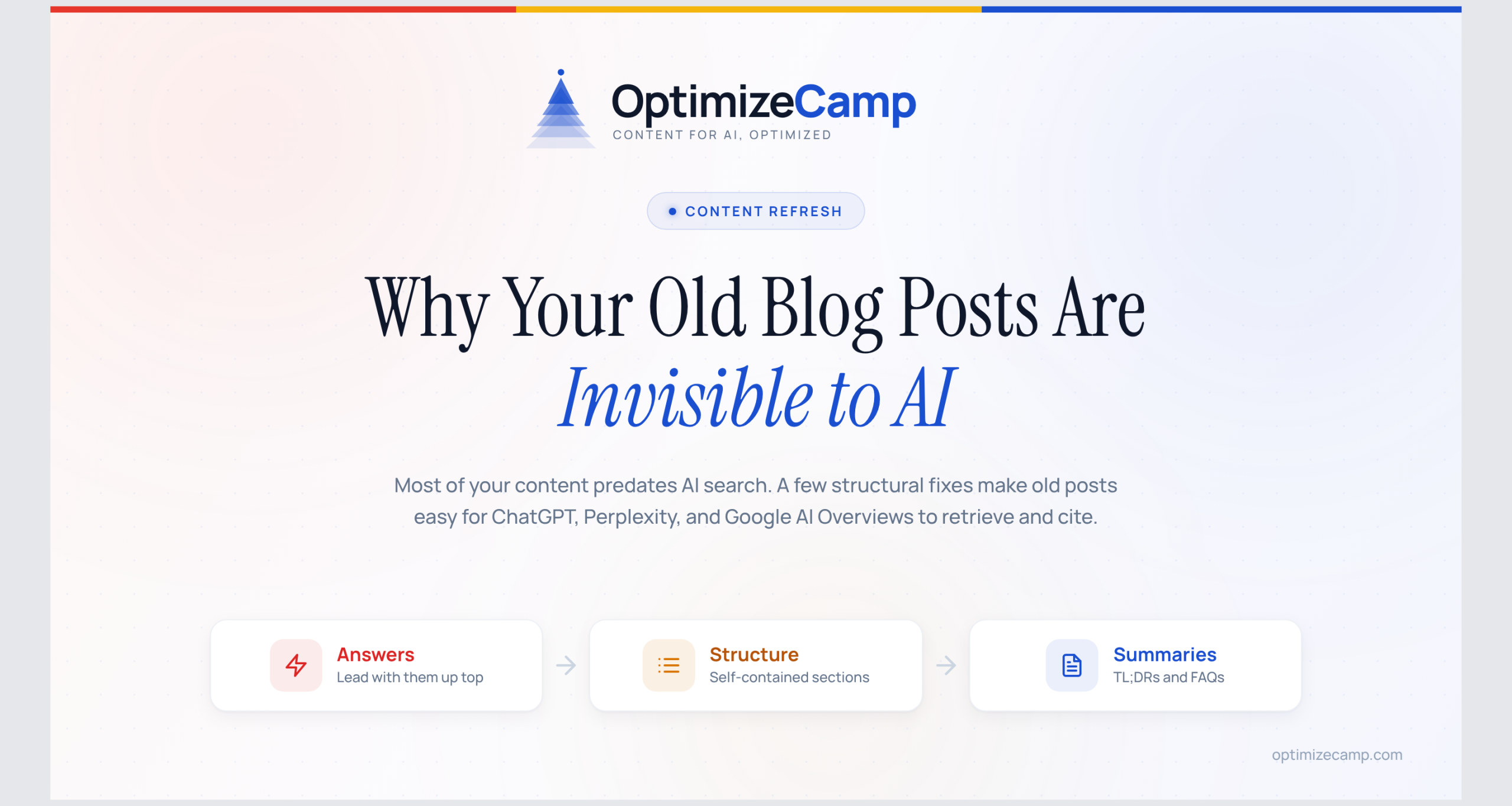
You don’t always need to publish more content to improve your AI visibility. Often, your biggest opportunity is already sitting in your archive, in the posts you published months or years ago.
Here is the uncomfortable part. Most of the content on your site was written before tools like ChatGPT, Claude, Gemini, and Perplexity changed how people look for answers. Those posts were never built with AI search in mind, because AI search barely existed when you wrote them.
Even your recent posts may have the same problem. If they were written the way blog posts have always been written, they were optimized for one reader: a human scanning the page. That is not a mistake. Serving human readers is, and should be, your first job.
But the place where people ask questions has shifted. A growing share now ask an AI assistant directly. They skip the page of blue links entirely. So a post can still rank on Google and still earn traffic. Yet it rarely appears when someone asks an AI the same thing. The content usually isn’t the problem. The structure is.
This article covers why older posts struggle in AI answers. It also shows the structural changes that make them easy to retrieve again, for both readers and AI.
AI Doesn’t Read Articles the Way Humans Do
AI systems rarely read your article from top to bottom. Instead, they retrieve the most relevant sections of a page and use those as context for an answer.
When you read a blog post, you usually start at the top. You keep going until you find what you came for. Large language models don’t work that way.
Rather than process a whole article every time, AI systems pull the passages that best match the question. Those passages, not the full page, become the raw material for the response.
This changes what you are competing on. Your article does not win or lose as a single document. Individual paragraphs, lists, and sections compete to be selected, not the whole page. If a section can’t answer a question on its own, it has little chance of being surfaced.
This is exactly why a pre-AI post struggles. It was written as one flowing argument, meant to be read in order. But it is now being judged one section at a time.
Why Older Posts Struggle to Get Picked
Most older posts struggle because they followed traditional SEO advice that works against retrieval.
For years, the standard blog formula looked something like this. Open with a long introduction. Build some suspense. Tell a story. Add context. Then, finally, answer the question.
That formula still has value for human readers. Many people enjoy a bit of build-up. But from a retrieval perspective, it creates friction at every step.
The Answer Comes Too Late
If a reader has to scroll through several paragraphs to reach the answer, an AI system faces the same delay. The information it needs is buried under setup. Surfacing the answer early makes the section far easier to retrieve and reuse.
One Section Covers Too Many Ideas
Sometimes a single heading tries to cover five different concepts at once. That makes it hard for an AI to tell what the section answers. Smaller sections, each focused on one idea, give a much clearer signal.
Generic Headings
Headings like Things to Consider, Tips, Best Practices, and Final Thoughts say almost nothing on their own. They give neither readers nor AI a reason to expect a specific answer below. Descriptive headings that name the question work far better, such as How to Optimize Existing Blog Posts for AI Search or Why Long Introductions Hurt AI Visibility.
Long Paragraphs
Large blocks of text are hard to scan and hard to parse. A reader’s eyes slide off them, and an AI has more trouble isolating a clean answer inside them. Shorter paragraphs, usually two to three sentences, keep each point easy to find.
Fixing these issues starts with a single shift in how you think about a page.
Write in Retrievable Chunks
The most useful mindset shift for AI visibility is this. Don’t think of a post as one long article. Think of it as a set of self-contained answer blocks.
Every major section should be able to stand on its own. Picture someone copying only that section into a separate document. Would it still answer a clear question by itself?
If the answer is yes, you are writing retrievable content. If the answer is no, that section probably needs reworking. The goal is for any section to make sense the moment it is lifted out of the page.
This does not mean writing robotic, mechanical content. It means giving every section one clear job. Readers benefit from that clarity as much as AI does.
It also matches how retrieval works under the hood. AI systems index and pull content in pieces, not as whole essays. Writing in clean blocks meets them where they already operate.
How to Update an Existing Post
You don’t need to rewrite every article from scratch. Often, a handful of structural changes is enough.
1. Answer the Main Question Immediately
Instead of spending several paragraphs setting up the topic, answer the core question in the first lines. Then expand with explanation, examples, and detail. Both readers and AI understand the page faster when the answer comes first.
2. Add a TL;DR Summary
A short summary near the top makes your key takeaways visible at a glance. It helps a hurried reader decide to stay. It also reinforces the page’s main topic in a clean, quotable block. This post opens with one, as an example.
3. Rewrite Vague Headings
Every heading should describe exactly what follows. Replace a bare Benefits with Benefits of Updating Old Blog Posts for AI Visibility. The second version tells readers and AI precisely what the section delivers.
4. Break Large Sections Into Focused Ones
Rather than one sprawling section covering everything, split it into several focused ones. For example: Why AI Retrieval Works Differently, Common Problems in Older Posts, and How to Improve Existing Content. Each heading then answers a single, specific question.
5. Add an FAQ Section
FAQ sections naturally produce short, self-contained answers to common questions. They help readers and give AI systems extra, clearly labeled passages to retrieve. Focus on questions people genuinely ask, like whether they should rewrite every post or how long results take. You will find a short FAQ at the end of this post.
6. Cut the Filler
For each paragraph, ask one question: does this help answer the topic? If it doesn’t, tighten it or remove it. Clear writing almost always beats longer writing.
A Worked Example
A small change to your opening can make the difference. Imagine you are writing about AI visibility.
The pre-AI instinct is to open with throat-clearing:
Artificial intelligence has changed the way people search for information. Over the past few years, numerous AI tools have emerged…
The retrievable version answers first:
Updating old blog posts can improve AI visibility because it makes your content easier for AI systems to retrieve and understand.
The second version hands the reader the answer right away. The rest of the section is then free to explain why. That is the answer-first pattern in a single edit.
Which Posts Should You Update First?
If you have hundreds of articles, don’t try to refresh them all. Start with the pages that already carry weight.
Look for posts that rank on Google, pull steady traffic, cover evergreen topics, earn backlinks, and still hold accurate information. These pages already have authority. Improving their structure usually pays off faster than publishing something brand new.
You can also prioritize by data instead of guesswork. An AI visibility tracker shows which of your pages get cited in AI answers and which never appear. The high-value pages with no AI presence are the ones to fix first.
AI Visibility Is Mostly Better Organization
Most of AI visibility comes down to one thing: making your existing knowledge easier to retrieve.
Many people assume AI visibility demands entirely new writing skills. In reality, it leans on fundamentals you already know. Clear headings. Direct answers. Focused sections. Helpful summaries. A logical structure.
None of this serves AI alone. Readers find answers faster. Search engines understand your pages better. And AI assistants are far more likely to pull your content when they answer a question. Better organization wins on every channel at once.
Refresh Before You Publish Something New
If you have been shipping fresh content every week, pause and look at what you already have. A well-structured post from three years ago can outperform a brand-new one, as long as it is easier to understand and retrieve.
AI visibility is not only about producing more. It is about producing content that is easy to find, easy to understand, and easy to cite.
So the next time you open an old post, skip the usual question. Don’t only ask whether the information is still accurate. Ask a sharper one instead:
If an AI could use only one section from this article, which section would it choose?
If you don’t know the answer, you have found the first thing to improve. Open your five best posts this week and ask it of each one.
FAQ
Should I Rewrite Every Old Blog Post?
No. Start with posts that already rank, earn traffic, or attract backlinks. Restructuring a page that already has authority delivers results faster than rewriting low-value posts or starting from zero.
Does AI Visibility Replace Traditional SEO?
No. The two work together. Strong SEO still drives the rankings and traffic that prove a page has value. AI visibility builds on that foundation by making the same content easy for AI systems to extract and cite.
How Long Does It Take to See Results?
It varies. AI systems re-crawl and re-index pages on their own schedules, so changes are not instant. Restructuring high-authority pages that are already indexed tends to show up sooner than waiting on brand-new content.
How Do I Know Which Posts AI Already Cites?
Check directly. Ask the AI assistants your audience uses the questions your posts target, then see whether your pages appear. An AI visibility tracker automates this across ChatGPT, Claude, Gemini, Perplexity, and Google AI Overviews, so you can spot the gaps at scale.
What Is the Difference Between Writing for Readers and Writing for AI?
Less than you might expect. Both reward clarity, direct answers, and focused sections. The main shift for AI is structural: organize the page so any single section can stand on its own and answer a question without the rest of the article.
Leave a Reply