


When you ask Google’s AI Mode or ChatGPT a real question, the system rewrites it. It splits your one question into a batch of narrower ones. Then it searches all of them at once and blends the findings into a single answer.
That process is called query fanout. It is the single most important mechanic in AI search, and most people have never heard of it.
This guide explains it without jargon. You will see a real question fan out into ten hidden searches. You will learn the eight types of questions these systems invent. And you will get a simple test, the 10-Question Test, to score any page you own.
Longer questions carry more intent. Fanout is how the machine unpacks it.
- What Is Query Fanout?
- How Query Fanout Works, Step By Step
- One Search Becomes Ten: A Worked Example
- Why AI Search Splits Your Question At All
- The Eight Kinds Of Questions AI Search Invents
- Which AI Engines Use Query Fanout?
- Not Every Search Fans Out
- What Query Fanout Changes About SEO
- Pages Do Not Get Retrieved, Sections Do
- The 10-Question Test: Score Your Own Page
- How To Write Sections That Win More Than One Sub-Query
- How To Tell If Any Of This Is Working
- Frequently Asked Questions
- What To Do This Week
What Is Query Fanout?
Query fanout is a retrieval technique where an AI search engine breaks one question into several narrower sub-queries. It runs those searches in parallel across the web and other data sources. It then merges the results into a single written answer. Google named the technique publicly when it launched AI Mode in May 2025.
The short version: you ask once, the engine searches many times, and you only see the summary.
Google’s own description is straightforward. AI Mode breaks your question into subtopics, then issues a multitude of queries at the same time on your behalf. Google’s help documentation says AI Overviews may use the same technique.
You will also see it written as “query fan-out”. Both spellings mean the same thing. Google’s patents use a drier name for it: query variant generation.
How Query Fanout Works, Step By Step
Query fanout runs in five stages: read the question, split it, search everything at once, score the passages, then write the answer. The whole sequence finishes in a couple of seconds. Nothing about the middle three stages is visible to the person searching.
Stage four is where visibility is won or lost. That claim gets its own section further down.
One Search Becomes Ten: A Worked Example
Take a normal shopping question: “best budget laptop for video editing”. A traditional search matches that phrase. Query fanout does something else entirely. It generates a spread of sub-queries covering price, software, hardware, alternatives and freshness, then searches all of them.
Here is what that spread looks like in practice.
Notice what is missing from that list. Almost none of them contain the original phrase. A page built only around “best budget laptop for video editing” competes for one of ten searches and ignores nine.
Notice the last one too. It is a question aimed back at you, not at the web. That type has a name, and it appears in the next section but one.
Why AI Search Splits Your Question At All
AI search splits questions because the questions got longer and messier. According to iPullRank’s December 2025 research with Similarweb, queries submitted to AI search average 70 to 80 words. Traditional Google queries average 3 to 4. A single keyword match cannot serve an 80-word request with five constraints inside it.
Fanout also improves accuracy. Pulling evidence from many documents gives the model more to check itself against. That reduces the odds of a confident wrong answer.
There is a scale story here as well. Google has said its Deep Search feature can issue hundreds of sub-queries for a single complex question. iPullRank’s analysis of the underlying patents found these systems run roughly 20 refinement rounds before stopping.
Those three numbers explain the shift on their own. Longer questions, more searches, more chances to be included or left out.
The Eight Kinds Of Questions AI Search Invents
The sub-queries are not random. iPullRank’s December 2025 patent analysis identified eight distinct variant types these systems generate. Knowing the eight turns fanout from a mystery into a checklist. Most content covers two of them well and ignores the rest.
Entailment is where most sites lose, because it is the question the reader never thought to type. Somebody shopping for a cheap editing laptop does not ask whether a dedicated GPU matters. The engine asks on their behalf, and cites whoever answered it clearly.
Which AI Engines Use Query Fanout?
Every major AI search product decomposes queries, but they do it differently and describe it differently. Google is the only one that uses the phrase “query fanout” publicly. The others run comparable pipelines under different names, or say nothing about the mechanics at all.
| Engine | How It Expands Queries | Named Publicly? |
|---|---|---|
| Google AI Mode & AI Overviews | Large parallel bursts across the web, Knowledge Graph, Shopping Graph and Maps | Yes, called query fan-out |
| Microsoft Copilot | Bing’s Orchestrator generates queries in rounds, each informing the next | Partly, described as grounding |
| Perplexity | Hybrid retrieval with multi-stage ranking, treating page sections as retrieval units | No, framed as retrieval architecture |
| ChatGPT Search | Reformulates and runs multiple lookups, then cites sources | No, mechanics undisclosed |
The differences matter less than the pattern. Decomposition is now the default everywhere.
Not Every Search Fans Out
Fanout is triggered by complexity, not by every query. Simple factual questions get little or no decomposition, because there is nothing to decompose. Questions carrying several conditions trigger heavy fanout. iPullRank’s analysis contrasts a basic lookup like the capital of Germany with a multi-constraint product question.
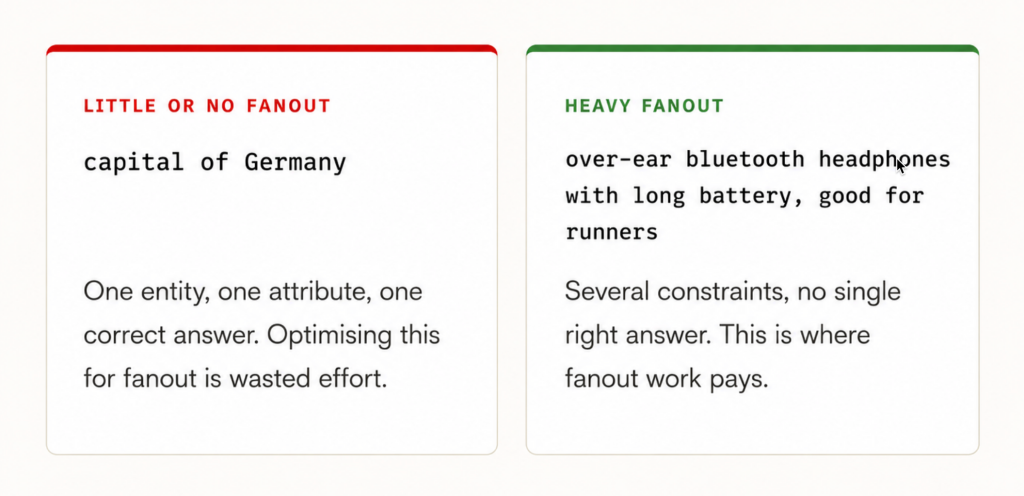
Spend your fanout effort on messy, multi-condition topics, not on definitions. Definitions still win through ordinary snippets and short answers.
What Query Fanout Changes About SEO
Query fanout breaks the one keyword, one page assumption. Your page is no longer competing for the phrase somebody typed. It competes for a set of invented sub-queries that neither of you can see. Ranking first for the visible keyword no longer guarantees inclusion in the answer.
The reverse is also true, and it is the better news. A page that ranks nowhere for the head term can still be cited. It only has to be the clearest answer to one hidden sub-query.
There is a second complication. Fanout is personalised, so two people asking the same question can trigger different sub-queries. Your visibility is a spread of outcomes, not a fixed position. Read our guide to generative engine optimization for the wider strategy this sits inside.
Pages Do Not Get Retrieved, Sections Do
AI search retrieves passages, not whole pages. The system breaks documents into chunks and scores each one on its own. A chunk that surfaces for several different sub-queries gets promoted above chunks that only match one. That single detail is the highest-leverage thing to know about fanout.
So the goal shifts. You are not writing a page that covers a topic. You are writing sections that each stand alone and answer something completely.
The Princeton, Georgia Tech, Allen Institute and IIT Delhi research team tested what makes a passage citation-worthy. Their GEO paper (Aggarwal et al., presented at KDD 2024) ran nine tactics across thousands of queries. Three won clearly.
Note what did not work. Keyword stuffing produced no gain in the same tests. Evidence beats repetition, because a model needs something concrete to lift.
Placement matters too. Growth Memo’s 2026 analysis of LLM citations found most extraction happens early in a document.
Front-load your answers. Do not save the good part for the conclusion.
The 10-Question Test: Score Your Own Page
The 10-Question Test is a simple audit for fanout coverage. You generate the ten likely sub-queries for a topic, then check how many your page answers. Your score out of ten tells you how much of the hidden search you are visible for. Most pages score three or four on the first try.
Step 1: Pick One Page And One Question
Choose a page that matters commercially. Write down the one question a reader would ask to find it.
Step 2: Generate The Ten Sub-Queries
Ask an AI model to expand your question using the eight variant types above. Force at least one equivalent, one generalization, one specification, one entailment and one follow-up. Those five are where coverage usually breaks.
Step 3: Score Each One Honestly
Give a point only if your page answers that sub-query in a single self-contained passage. Partial coverage scores zero. A reader should be able to lift that passage out and still understand it.
Step 4: Fix The Cheapest Gaps First
Add a clearly labelled section for each missing sub-query. Keep each new section short and complete. Do not bury it inside an existing paragraph.
Step 5: Re-Score In Thirty Days
Run the same test after the page is recrawled. Track your score over time, not your keyword position.
Run the test on your five most valuable pages before touching anything else. The pattern in your misses is usually the same across all five.
How To Write Sections That Win More Than One Sub-Query
Write each section so it can be lifted out and still make sense. That means a plain heading, a direct answer in the first sentence, and no dependence on the paragraph above it. Sections built this way can match several sub-queries at once, which is what pushes them up the ranking.
- Use literal headings. “How Much RAM For Video Editing” beats “The Memory Question”.
- Answer in the first sentence. Never build up to the point.
- Name your entities. Write the full product, tool or brand name instead of “it”.
- Keep passages self-contained. Roughly a short paragraph or two per idea.
- Attach evidence. One named source or number per section.
One warning. Do not chop your content into artificial fragments to game the chunking. Google has said publishers do not need to pre-chunk pages for its generative features. Clear structure is the goal, not confetti.
Our GEO content audit framework covers how to apply this across a whole site rather than one page.
How To Tell If Any Of This Is Working
Measure citations, not rankings. Because fanout personalises the sub-queries, the same question produces different expansions for different people. A keyword position cannot capture that. What you can track is how often your brand and pages appear inside AI answers over repeated runs.
There is a subtler metric worth watching. AI systems retrieve far more sources than they cite. Being retrieved and then dropped is a content problem, not a discovery problem.
If you are being found but not quoted, your passages lack something concrete to lift. Add the number, the named source, or the direct answer. Tracking this across engines is exactly what OptimizeCamp was built to do.
Frequently Asked Questions
What Is Query Fanout In Simple Terms?
Query fanout is when an AI search engine turns your one question into several hidden searches, runs them together, and merges the results into one answer. You never see the extra searches. You only see the summary they produced.
How Many Sub-Queries Does Query Fanout Generate?
It varies with complexity, and published estimates disagree. Most analyses of ordinary questions land between eight and twenty sub-queries. Google has said its Deep Search feature can fire hundreds for a single complex research question.
Is Query Fanout The Same As Query Fan-Out?
Yes, they are the same thing with two spellings. Google uses the hyphenated form in its announcements. Google’s patents use a third name, query variant generation.
Does Query Fanout Happen On Every Search?
No. Simple factual questions trigger little or no fanout, because a single answer already exists. Questions with several conditions, comparisons or preferences trigger heavy fanout.
Can I See The Sub-Queries Google Generates?
Not directly, since Google does not expose them. Several free tools simulate the expansion using the same patent logic, and Perplexity displays some of its internal searches in the interface. Simulation is close enough to audit against.
Does Ranking Number One Still Matter With Query Fanout?
It helps, but it no longer guarantees inclusion. AI engines retrieve passages for sub-queries you did not target, and cite whichever source answers each one best. A page ranking outside the top ten can still be cited.
What To Do This Week
Pick your most valuable page and run the 10-Question Test on it. Write the ten sub-queries, score your coverage, and add a clearly labelled section for the two biggest gaps. That one hour of work does more than another round of keyword research.
Leave a Reply