

They’re not competing disciplines. They’re three layers of the same visibility stack – and ignoring any one costs you traffic.
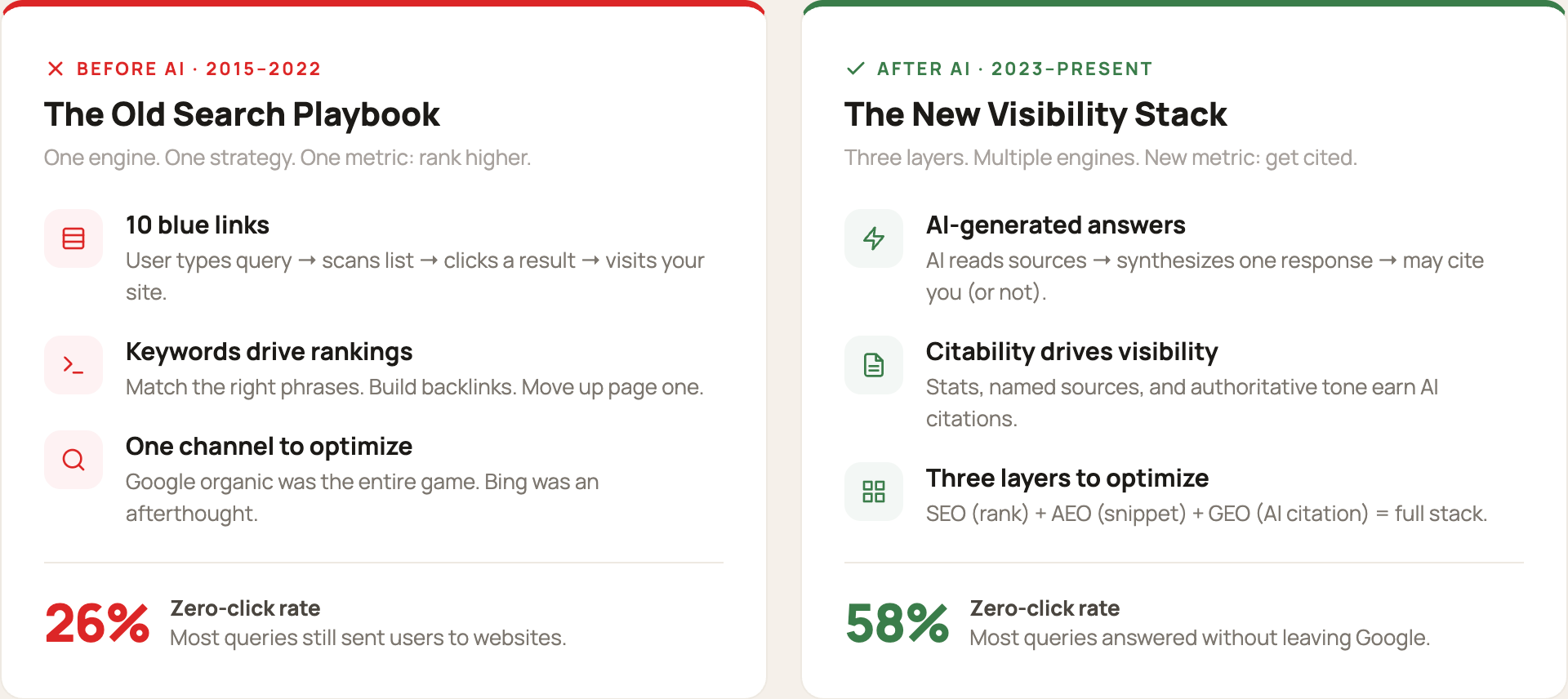
58% of Google searches now end without a click. That number was 26% five years ago. The culprit is AI – Google’s AI Overviews, ChatGPT Search, Perplexity, and a growing fleet of generative engines that answer questions directly.
Three acronyms have emerged to describe the new optimization landscape: SEO, GEO, and AEO. The industry can’t agree on what each means. Some say GEO replaces SEO. Others call AEO a subset of GEO. Rand Fishkin says they’re all “tags under SEO.”
Here’s what the data shows: they’re concentric layers, not competitors. Strong SEO feeds AEO wins. AEO-ready content becomes GEO-citable material. Skip any layer and you leak visibility across all three.
This guide breaks down exactly what each discipline targets, where they overlap, where they diverge, and which to prioritize – backed by 40+ sourced stats from 2024–2026 research.
What SEO, GEO, And AEO Actually Mean
SEO, GEO, and AEO each optimize for a different answer-delivery mechanism. SEO targets ranked links in search results. AEO targets direct-answer placements like featured snippets and voice results. GEO targets citation inside AI-generated responses from ChatGPT, Perplexity, and Google AI Overviews.
The distinction matters because each mechanism rewards different content signals. A page ranking #1 on Google might never appear in an AI Overview. A perfectly structured FAQ might win a featured snippet but get ignored by ChatGPT. Understanding what each engine wants is the first step to appearing everywhere.
Neil Patel offers a clean taxonomy: AEO handles featured snippets and voice, GEO covers AI Overviews and generative summaries, and LLMO addresses long-form AI citations. But he emphasizes "they aren't separate marketing channels." They're extensions of SEO.
How Search Behavior Is Changing In 2025–2026
The shift from links to answers is accelerating. Google still holds 89–90% of global search market share, according to StatCounter. But that's the first sustained dip below 90% since 2015. Meanwhile, AI search platforms are exploding.
ChatGPT processes 2.5 billion prompts daily with 800+ million weekly active users. Perplexity serves 45 million monthly active users running 780 million queries per month - a 239% year-over-year increase. Google's Gemini has surpassed 750 million monthly users. AI referrals to top websites surged 357% year-over-year between June 2024 and June 2025, per BrightEdge.
But perspective matters. AI platforms still generate only about 1% of total web referral traffic. Google sends 345 times more traffic than all AI platforms combined, per Search Engine Land's March 2025 analysis. The opportunity is massive but nascent.
SEO Still Drives 53% Of All Website Traffic
SEO is not dying. It's evolving into the prerequisite layer for everything else. Organic search drives 53.3% of all trackable website traffic, according to BrightEdge's 2025 research. It generates twice as much B2B revenue as every other digital channel combined.
Google processes 9–14 billion searches daily. Search volume grew 22% in 2024. The pie is getting bigger - but each slice delivers fewer clicks.
Since AI Overviews launched, zero-click searches surged from 56% to 69%, per Similarweb. For every 1,000 U.S. Google searches, only 360 clicks reach non-Google properties. Seer Interactive's gold-standard study found organic CTR drops 61% when AI Overviews appear - from 1.76% to 0.64%.
But here's the critical bridge to GEO: 97% of AI Overviews cite at least one source from the organic top 20, per seoClarity. Pages cited inside AI Overviews receive 35% more organic clicks than uncited pages. Ranking well in traditional search remains the prerequisite for AI citation.
GEO Targets AI Citation, Not Rankings
GEO was formalized in a landmark 2023 paper by researchers from Princeton, IIT Delhi, and Georgia Tech. Titled "GEO: Generative Engine Optimization," it was accepted to KDD 2024 and tested nine optimization methods across 10,000 queries. The central finding: GEO methods can boost source visibility by up to 40% in AI-generated responses.
The single most effective tactic was embedding statistics - quantitative data instead of qualitative discussion. This improved visibility by 41%. Adding named citations produced 30–40% gains. Expert quotations delivered up to 32% improvement. Keyword stuffing - SEO's oldest trick - actually reduced visibility by up to 10%.
Why does this happen? Generative engines use Retrieval-Augmented Generation (RAG). They convert queries into semantic representations, retrieve relevant documents, then synthesize responses with inline citations. The average AI search query runs about 23 words - versus 4 words for traditional Google searches. There's no "page two." Content is either cited or invisible.
A Yext Q4 2025 study confirmed the research findings at scale. Data-rich websites received 4.3 times more citation occurrences per URL than directory listings. Content written at a 9th-grade reading level earned 20% more citations than jargon-heavy equivalents.
The GEO market reflects this urgency. Valuates Reports projects GEO services will reach $7.3 billion by 2031 at a 34% CAGR. BrightEdge found 68% of organizations are already changing strategies for AI search. Yet 47% of brands still have no deliberate GEO strategy - a first-mover window that's closing fast.
AEO Wins The Direct Answer
AEO predates GEO by a full decade. It emerged with Google's Featured Snippets in 2014 and the voice assistant boom of 2015–2017. Where GEO asks "how do I get cited by AI?", AEO asks a simpler question: how do I become the direct answer?
Featured snippets achieve a 42.9% CTR according to First Page Sage - higher than any other SERP element. Voice search results average 29 words and load 52% faster than typical pages. There are 8.4 billion voice-enabled devices worldwide, per Statista - more than the global population.
The AEO toolkit centers on structured data and question-based formatting. FAQ schema, HowTo schema, and QAPage markup in JSON-LD tell search engines exactly what your content represents. Google and Microsoft both confirmed in March 2025 that they use schema for generative AI features. ChatGPT confirmed structured data influences which products appear in its results.
Yet adoption is shockingly low. Only 30% of web pages use Schema.org markup. Domain-level usage sits as low as 0.3%, per KeyStar Agency. Rotten Tomatoes saw 25% higher CTR with structured data. Food Network achieved a 35% traffic increase after converting 80% of pages to schema. The gap between early adopters and the rest is enormous.
The Visibility Stack: How SEO, GEO, And AEO Fit Together
The relationship among these three disciplines is a nested hierarchy - not a Venn diagram. Think of it as the Visibility Stack: SEO is the foundation, AEO is the formatting layer, and GEO is the citation layer. Each builds on the one below.
The data proves this dependency chain. According to seoClarity, 99% of AI Overview citations come from the organic top 10. Xseek research found 87% of ChatGPT citations correspond to top Bing results. Without strong SEO fundamentals, neither AEO nor GEO can succeed.
Rand Fishkin's "Three Graphs" model adds nuance. AI visibility requires presence across the Entity Graph (verified facts, Knowledge Panel), the Document Graph (indexed, ranked pages), and the Concept Graph (LLM-learned associations). Brands present across all three receive disproportionate AI visibility.
Lily Ray of Amsive reinforces the hierarchy. At MozCon 2025, she argued that GEO is not a replacement for SEO — it's what happens when you do SEO well for the AI era. She called out "GEO grifters" who repackage core SEO principles under a new acronym and charge premium prices.
SEO Vs GEO Vs AEO: Head-To-Head Comparison
The overlap between these three disciplines is substantial - roughly 70% shared. Every GEO best practice (structured data, authoritative content, E-E-A-T signals, clear formatting) is also an SEO and AEO best practice. The differences lie in emphasis and what you measure.
| Dimension | SEO | GEO | AEO |
|---|---|---|---|
| Primary target | Ranked organic links | AI-generated citations | Featured snippets & voice |
| Key platforms | Google, Bing, Yahoo | ChatGPT, Perplexity, AI Overviews, Gemini | Featured Snippets, PAA, Siri, Alexa |
| Content format | Pages optimized for queries | Extractable, data-rich paragraphs | Concise Q&A blocks (40–50 words) |
| Success metric | Rankings, organic CTR, traffic | Citation rate, AI Share of Voice | Snippet wins, Position Zero rate |
| Technical signals | Core Web Vitals, crawlability | Schema, llms.txt, cross-platform mentions | FAQ/HowTo schema, fast load speed |
| Link signals | Backlinks (authority, relevance) | Brand mentions across trusted platforms | Domain authority (top-3 ranking needed) |
| Content tone | Varies by intent | Authoritative, declarative, data-first | Direct, concise, answer-first |
| Maturity | 30+ years | ~2 years (formalized 2023) | ~10 years (formalized ~2014) |
| Market size | $74.9B (2025) | $7.3B by 2031 (34% CAGR) | Subset of SEO market |
Which Should You Prioritize In 2026?
Start with SEO. It still drives 53% of traffic and is the prerequisite for AI citation. Layer AEO next - structured data, FAQ formatting, and concise answer blocks require minimal effort with outsized returns. Then invest progressively in GEO - statistics inclusion, expert citations, and cross-platform brand presence.
Neil Patel urges urgency on GEO specifically. GEO traffic already converts competitively with organic search. And the market is early. 85% of marketing leaders view GEO as critical, but only 34% of companies have trained their teams. That gap is your opportunity.
BrightEdge CEO Jim Yu's advice cuts through the noise: focus on influencing content outside your website that shapes what AI says about your brand. Reviews on G2, Capterra, and Trustpilot. Reddit presence. LinkedIn thought leadership. Wikipedia accuracy. These cross-platform signals feed LLM training data and RAG retrieval.
2. Add 2–3 named statistics to every pillar content page.
3. Rewrite opening paragraphs as 40–60 word answer capsules.
4. Check if your robots.txt blocks GPTBot or ClaudeBot. Unblock them.
2. Produce original research or data that AI engines can't generate.
3. Track AI citation frequency using tools like OptimizeCamp or manual Perplexity/ChatGPT audits.
4. Add expert quotations to your top 10 content assets.
The brands winning the AI era aren't choosing between SEO, GEO, or AEO. They're building what Fishkin calls "cascading confidence" - verifiable facts, strong rankings, and consistent cross-platform authority. That compound effect is the moat. Tools like OptimizeCamp can audit your content across all three dimensions - accuracy, authority, and citability - so you know exactly where each page needs work.
The window for building that authority with manageable competition is open now. The 34% CAGR in GEO spending tells you it won't stay open long.
Frequently Asked Questions
Is GEO Replacing SEO?
No. GEO builds on SEO, not replaces it. 99% of AI Overview citations come from the organic top 10, per seoClarity. Without strong SEO fundamentals - quality content, authoritative backlinks, technical health - GEO cannot succeed. Lily Ray called this out at MozCon 2025: GEO is what happens when you do SEO well for the AI era.
What Is The Difference Between GEO And AEO?
AEO targets direct-answer placements like featured snippets, voice results, and People Also Ask boxes. GEO targets citation inside AI-generated responses from ChatGPT, Perplexity, and Google AI Overviews. As Planit Agency put it: AEO helps you appear in the answer. GEO helps you become the source behind the answer.
How Do You Measure GEO Success?
GEO metrics include AI citation frequency, Share of AI Voice, brand mention rate in AI responses, and AI referral traffic in analytics. Only 23% of marketers currently invest in prompt tracking and GEO measurement. Tools like OptimizeCamp audit content for citability signals - statistics density, source attribution, and extractable formatting.
Does Schema Markup Help With GEO?
Yes. Google and Microsoft both confirmed in March 2025 that they use schema markup for generative AI features. ChatGPT also confirmed structured data influences product visibility. FAQPage, Article, HowTo, and Product schema types in JSON-LD help AI systems identify and extract relevant content passages.
How Big Is The GEO Market?
The GEO services market was valued at $886 million in 2024 and is projected to reach $7.3 billion by 2031 at a 34% CAGR, according to Valuates Reports. The broader SEO market stands at $74.9 billion in 2025, projected to reach $149 billion by 2031 at 12.1% CAGR, per Mordor Intelligence.
Can Small Sites Compete In GEO?
The Princeton GEO study found that smaller, less-known sites benefited more from GEO tactics than established brands. Adding statistics and citations improved visibility for lower-ranked domains by up to 115%. This makes GEO a potential equalizer - original data and expert-sourced content can outperform brand authority alone in AI-generated responses.
Leave a Reply