

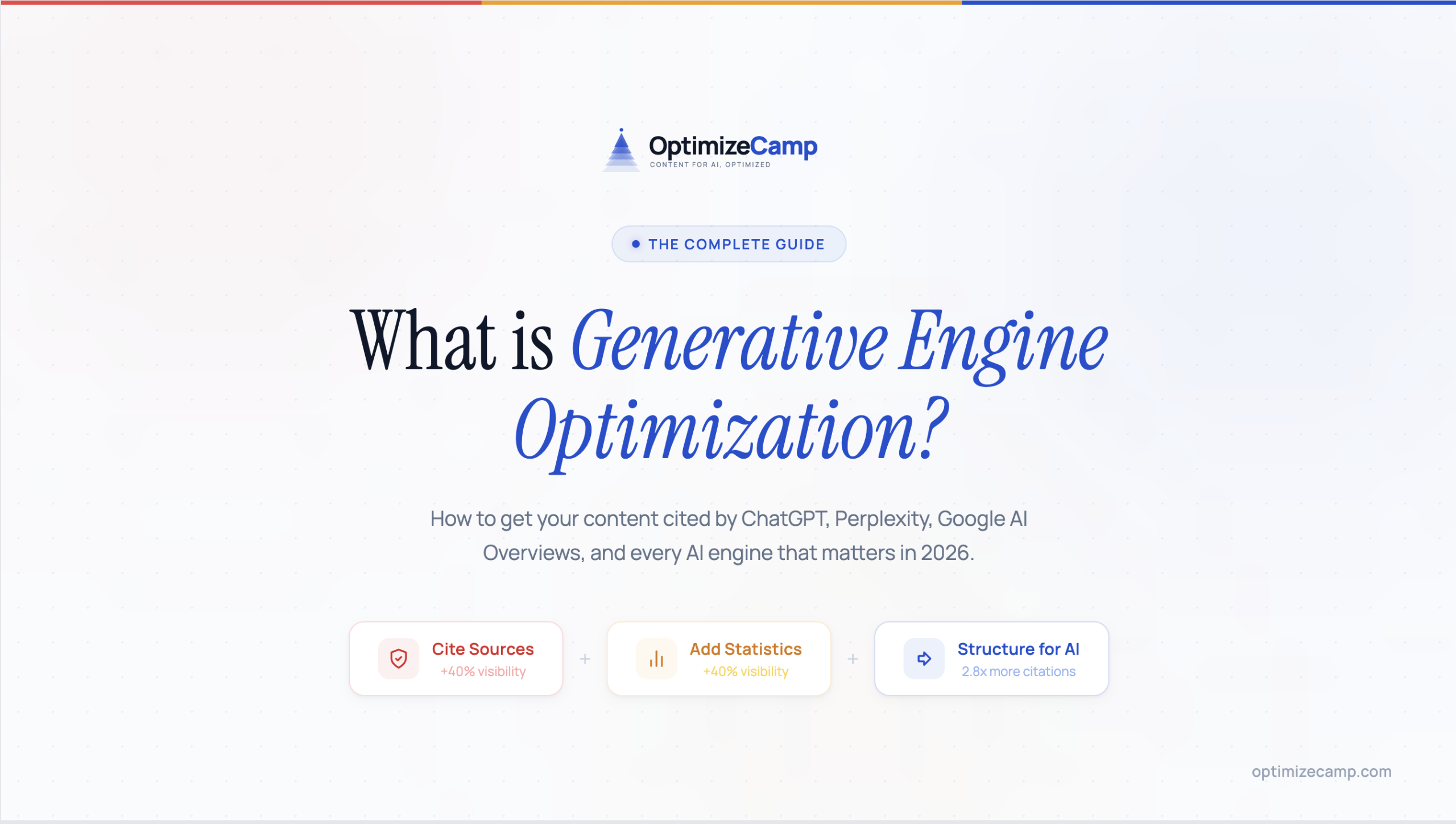
Something broke in search. Quietly. Around late 2024, people stopped clicking blue links. They started asking AI for answers instead. ChatGPT. Perplexity. Google AI Overviews. Claude. These aren’t search engines. They’re answer engines. They don’t rank your page. They read it, decide if it’s trustworthy, and either cite you – or ignore you entirely.
Generative Engine Optimization is how you earn those citations. GEO is the practice of structuring your content so AI platforms retrieve it, trust it, and reference it when generating answers. Think of it this way. SEO gets you into the library. GEO gets you recommended by the librarian.
The term came from researchers at Princeton University. In 2023, they published a paper introducing GEO as a formal discipline. They tested nine optimization strategies across thousands of content samples. Their finding was stark. The right techniques boost AI visibility by up to 40%.
Here’s what makes this different from SEO. Traditional search shows ten blue links. The user picks one. Generative search shows one synthesized answer. That answer pulls from multiple sources. Your content either makes the cut – or it doesn’t exist.
No page two. No second chance. You’re cited, or you’re invisible.
Why GEO Matters Right Now
The numbers are brutal. And they’re accelerating. Every metric points in the same direction: AI search isn’t coming. It’s already here. The businesses that understand this will eat the ones that don’t.
60%
of Google searches now end without a single click. Users get their answer from AI Overviews and never visit a website.
Source: Incremys GEO Statistics Report, 2026
800M+
Weekly active users on ChatGPT alone
25%
Drop in traditional search predicted by Gartner by end of 2026
2.6%
CTR for position #1 when an AI Overview appears
Read that last number again. Position one – the holy grail of SEO – now earns a 2.6% click rate when an AI Overview sits above it. That’s down from roughly 30% without an overview. A 90% collapse in clicks.
But here’s the twist. 99% of AI Overview citations come from pages already in the organic top 10. SEO isn’t dead. It’s necessary but no longer sufficient. You need to rank well AND be citation-worthy. That second part is GEO.
The early adopters are already seeing results. Businesses that implement GEO now report 22% higher ROI on content. They see 40% more visibility in AI-generated answers. Their traffic from AI referrals is growing 300% year-over-year. Some retail sites report over 500% increases.
The window to move first is closing fast. By 2028, McKinsey projects 75% of all search queries will run through generative engines. Half of all searches will be generative by end of this year. Waiting is a strategy. A bad one.
How AI Search Actually Works
To win at GEO, you need to understand the machine. AI search engines don’t work like Google’s traditional algorithm. They use a process called Retrieval-Augmented Generation – or RAG. Here’s the step-by-step.
Step 1 → Query Interpretation
The AI reads the user’s question. It identifies intent, key concepts, and sub-questions. Complex queries get broken into smaller pieces. “Best project management tool for remote teams under 20 people” becomes three separate sub-queries.
Step 2 → Source Retrieval
The engine searches its training data and live web results. It pulls potentially relevant documents. High-authority, recent, and topically dense content gets prioritized. This is where your SEO foundation matters.
Step 3 → Source Evaluation
Retrieved sources get scored for authority, accuracy, and relevance. Content with citations, data, and clear expertise scores higher. This is where GEO optimization lives. The engine decides who to trust.
Step 4 → Synthesis
The AI blends information from multiple trusted sources into one coherent answer. It selects the most relevant details from each. Your content either contributes a sentence – or gets left out.
Step 5 → Citation
Some platforms (Perplexity, Google AI Overviews) link back to sources. Others (ChatGPT, Claude) may mention the brand without a link. Either way, this is the moment you either exist in the AI’s answer – or you don’t.
Here’s the critical insight. LLMs extract sentences, not paragraphs. They look for self-contained, verifiable claims. Vague statements like “many companies benefit from AI” are invisible. Precise statements like “63% of companies that optimized for GEO reported increased AI visibility” get cited.
The AI isn’t reading your content the way a human does. It’s scanning for extractable, trustworthy claims.
SEO vs GEO vs AEO – Untangled
These three acronyms are everywhere. Most people use them interchangeably. They shouldn’t. Here’s the actual difference.
| SEO | GEO | AEO | |
|---|---|---|---|
| Goal | Rank higher in search results | Get cited in AI-generated answers | Appear in answer boxes & snippets |
| Optimizes for | Google, Bing (10 blue links) | ChatGPT, Perplexity, Claude, Gemini | Google Featured Snippets, Voice |
| How it works | Keywords, backlinks, technical SEO | Citations, statistics, structured claims | Q&A format, schema, concise answers |
| Success metric | Ranking position, organic traffic | AI citation rate, Share of Model | Featured snippet capture rate |
| User experience | User clicks a link, visits your page | AI reads your page; user may never visit | User sees preview; may or may not click |
| Status in 2026 | Foundation. Still necessary. | The new frontier. Growing fast. | Merging into GEO. Overlapping. |
The short version: SEO is the foundation. GEO is the new layer on top. AEO is being absorbed into GEO as AI Overviews replace traditional featured snippets.
One statistic clarifies the relationship perfectly. 87% of ChatGPT’s web-browsing citations come from Bing’s top 10 results. If you’re not ranking, AI engines can’t find you. But ranking alone doesn’t guarantee citation. You need both.
GEO doesn’t replace SEO. It completes it.
The Princeton Study That Started It All
In 2023, researchers from Princeton, Georgia Tech, the Allen Institute for AI, and IIT Delhi published the foundational GEO research. It was presented at KDD 2024, one of the top data science conferences in the world. This paper gave GEO its name and its first empirical framework.
They tested nine different optimization methods. They measured which techniques actually improved visibility in AI-generated responses. The results were clear – and some were surprising.
| GEO Strategy | Visibility Improvement | Notes |
|---|---|---|
| Cite Sources | +40% | Highest impact. Works across all domains. |
| Add Statistics | +40% | Best for law, government, factual content. |
| Add Quotations | +40% | Expert quotes from recognized authorities. |
| Fluency Optimization | +30% | Improving sentence clarity and flow. |
| Readability | +15–30% | Simpler language, shorter sentences. |
| Unique Words | +12% | Distinctive vocabulary helps stand out. |
| Technical Terms | +9% | Domain-specific jargon (use carefully). |
| Authoritative Tone | +8% | Helpful for historical content. |
| Keyword Stuffing | -10% | HURTS visibility. Worse than doing nothing. |
Three strategies dominated. Adding citations from credible sources. Including concrete statistics. And inserting expert quotations. Each of these boosted visibility by up to 40%.
Stylistic improvements – better fluency and readability – gave a solid 15–30% lift. Even small changes to sentence clarity mattered.
And keyword stuffing? It actually hurt. It performed 10% worse than doing nothing at all. AI engines punish the exact trick that still works on some traditional search results.
The study also found that combining strategies compounds the effect. Using fluency optimization plus statistics together outperformed any single strategy by over 5.5%. Adding citations on top pushed combined performance even higher.
One more finding that changes everything. GEO results varied heavily by domain. Statistics worked best for law and government content. Citations worked best for factual queries. Authoritative language worked best for history. There’s no one-size-fits-all. Your strategy needs to match your niche.
9 GEO Strategies That Actually Work
These strategies are backed by the Princeton research, validated by 2025–2026 industry data, and refined by what we see working at OptimizeCamp. Ranked by impact.
1. Cite credible sources inline (+40% visibility)
Reference .edu, .gov, and established publications by name. AI engines use your citations as trust signals. Don’t just link – name the source in the sentence itself.
2. Add concrete statistics (+40% visibility)
“Traffic grew significantly” is invisible. “Traffic grew 147% in 6 months” gets extracted. Every section of your content should include a specific number. AI engines love defensible data points.
3. Include expert quotations (+40% visibility)
Named quotes from recognized authorities boost your content’s credibility in AI evaluation. The AI models the exact trust behavior humans use – citing someone credible increases its confidence.
4. Write in self-contained claims (High impact)
Each factual statement must work as a standalone sentence. LLMs extract sentences, not paragraphs. If your key insight requires three sentences of context, the AI may skip it.
5. Optimize fluency and readability (+15–30%)
Clear, well-structured sentences get prioritized. Cut jargon unless your domain requires it. Short paragraphs. Clean topic sentences at the start of each section. AI rewards parsability.
6. Use clear heading hierarchy (2.8x more citations)
Pages with clear H1→H2→H3 structure get cited 2.8 times more often. Start each H2 section with the core claim in the first sentence. Don’t bury the answer.
7. Add FAQ sections (Strong correlation)
80% of pages cited by AI contain lists or bullet points. FAQ sections at the end of articles map directly to how users prompt AI engines. Question-answer format mirrors query patterns.
8. Update content quarterly (Freshness signal)
79% of AI bots prefer recent content. Stale content decays faster in AI search than in traditional search. Add a visible “Last Updated” date. Refresh your statistics every 90 days.
🚫 What NOT to do
Keyword stuffing: The Princeton study proved it reduces AI visibility by 10%. AI engines detect it and downgrade your content.
Vague qualitative claims: “Many experts agree” does nothing. Name the experts. Cite the number. Be specific or be invisible.
Walls of text without structure: AI engines need to parse your content quickly. No headings = no extraction = no citation.
How each AI platform cites differently
Not all AI engines are the same. Each platform has its own citation behavior. What works on ChatGPT may not work on Perplexity. Understanding these differences is the advanced play.
ChatGPT
800M+ weekly users
Relies on a few authoritative sources. 48% of citations go to Wikipedia. 87% of web-browsing citations come from Bing’s top 10. Favors comprehensive coverage of topics.
Perplexity
Real-time web search
Acts like a research engine. Searches live for every query. Pulls from a wider range of sources, including niche content. Favors detailed, specific, well-structured pages.
Google AI Overviews
1.5B+ monthly users
Appears on 13–16% of US searches and growing. 99% of citations come from the organic top 10. Position #1 has a 33% chance of being cited. No special markup required.
Claude & Gemini
Growing rapidly
Less than 10% of sources they cite rank in Google’s top 10. These platforms surface authority differently — brand mentions, community presence, and expertise matter more.
Less than 10% of sources cited in ChatGPT, Gemini, and Copilot rank in Google’s top 10 for the same query. SEO alone does not guarantee visibility across all AI engines.
MarGen, The Definitive Guide to GEO, 2026
That quote is the entire argument for GEO in one sentence. Ranking #1 on Google helps with AI Overviews. It barely helps with ChatGPT, Claude, or Gemini. You need a separate strategy for each platform. Or at minimum, a unified approach that covers the overlapping signals.
How To Audit Your Content for GEO
You can’t optimize what you haven’t measured. A GEO content audit evaluates how AI-ready each page is. Here’s the framework we use at OptimizeCamp.
The GEO Content Audit Framework
- Accuracy check. Are your claims factually correct? Are statistics current? Do you cite sources for data points? AI engines verify claims before citing them. One wrong number can tank your credibility.
- Authority check. Does your content cover the topic comprehensively? What subtopics are competitors covering that you’re missing? How does your depth compare to the top 10 pages?
- Citability check. Is your content structured for extraction? Does every section have a clear heading? Are key claims self-contained sentences? Do you include statistics and expert quotes?
- Freshness check. When was this content last updated? Are the statistics from the last 6 months? Do temporal references still make sense? AI engines favor content updated within 2–3 months.
- Format check. Does your content include lists, tables, and comparison data? Do you have an FAQ section? Is reading level accessible? Is the content scannable?
Score each dimension from 0 to 100. Weight accuracy highest – factual trust is the foundation AI engines need. Authority second, because topical depth determines whether you’re a primary source. Citability third, because formatting determines whether AI can extract your insights.
Audit your top 20 pages first. These have the most traffic and the most to lose. Fix accuracy issues first. Then fill authority gaps. Then restructure for citability.
Measuring GEO Success
Old SEO metrics don’t capture GEO performance. Rankings still matter. But you need new KPIs for the AI era.
KPI
Share of Model (SoM)
How often your brand appears in AI responses vs competitors. The AI equivalent of market share. This is the north star metric.
KPI
AI Citation Rate
Percentage of relevant queries where AI engines cite your content. A 5% rate across 1,000 queries = 50 daily AI recommendations.
KPI
Citation Sentiment
Are AI engines citing you favorably or critically? Being mentioned isn’t enough. Track the language around your brand mentions.
KPI
AI Referral Traffic
Traffic from chat.openai.com, perplexity.ai, google AIO clicks. Growing 300%+ year-over-year across industries.
Here’s a practical way to start measuring. Pick your 10 most important keywords. Ask each AI engine those queries. Check if your brand appears. Track this monthly. That’s your baseline Share of Model.
Getting Started Today
GEO feels overwhelming. It isn’t. Start small and compound. Here’s the quickstart that works in one afternoon.
✅ The 1-Hour GEO Quickstart
- Pick your top 5 pages by traffic. These have the most to gain and the most to lose.
- Add 2-3 cited statistics per page. Include the source name inline. Not just a link – name the institution.
- Restructure with clear headings. Every H2 should start with the answer, not build to it. Frontload your claims.
- Add a FAQ section at the bottom. 3-5 questions that mirror how people prompt AI about your topic.
- Update the “Last Updated” date. AI engines check freshness. Make it visible on the page.
- Test your content against AI. Ask ChatGPT and Perplexity questions your content should answer. See if you get cited.
That’s it for day one. In week one, expand to your top 20 pages. In month one, audit your full site using the framework in Chapter 8. In month three, start tracking Share of Model. By month six, you’ll have data on what’s working.
GEO rewards consistency over perfection. A page that’s 70% optimized and updated quarterly beats one that’s 100% optimized and abandoned.
The discipline is new. The opportunity is enormous. And the early movers will have a compounding advantage that late adopters will spend years trying to close.
Start today. Start with one page. Make it citation-worthy.
See how AI-ready your content is
OptimizeCamp audits your content across accuracy, authority, and citability — the three signals AI engines use to decide who gets cited.
Leave a Reply